
UK Mattress Sizes in Centimetres Explained
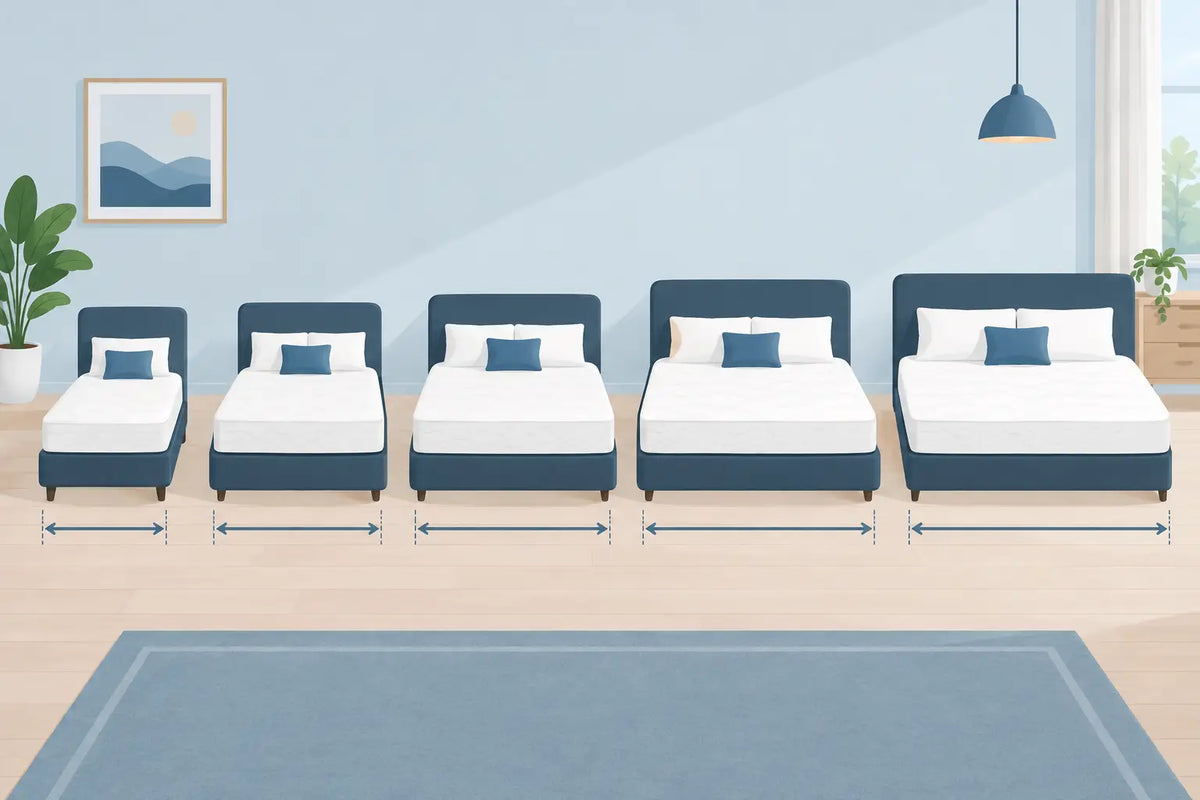
A mattress labelled “king size” sounds straightforward until it arrives 10 cm shorter than the frame you bought abroad, or leaves an awkward gap in an old bedstead. UK mattress sizes in centimetres give you the numbers that matter. Names are useful shorthand, but width and length are what determine whether a mattress will actually fit.
UK mattress sizes in centimetres
The dimensions below are the standard UK sleeping-surface sizes. Width comes first, followed by length.
| Mattress size | Dimensions in centimetres | Dimensions in feet and inches |
|---|---:|---:|
| Small single | 75 x 190 cm | 2 ft 6 in x 6 ft 3 in |
| Single | 90 x 190 cm | 3 ft x 6 ft 3 in |
| Small double | 120 x 190 cm | 4 ft x 6 ft 3 in |
| Double | 135 x 190 cm | 4 ft 6 in x 6 ft 3 in |
| King size | 150 x 200 cm | 5 ft x 6 ft 6 in |
| Super king | 180 x 200 cm | 6 ft x 6 ft 6 in |
| Emperor | 200 x 200 cm | 6 ft 6 in x 6 ft 6 in |
These measurements describe the mattress, not the outside of the bed. A divan normally follows the same footprint closely, while a wooden, upholstered or metal frame can be considerably wider and longer once its rails, headboard and footboard are included.
There can also be a small manufacturing tolerance. Mattresses have soft, upholstered edges rather than machined metal sides, so a finished size may vary slightly. That is normal. A difference of a few millimetres is not a fitting problem; a difference of several centimetres usually means the frame and mattress are based on different standards.
What each UK bed size is good for
Small single: 75 x 190 cm
A small single is often used for children, narrow guest rooms, bunk beds and compact day beds. It saves 15 cm of width compared with a standard single, which can make a tight room easier to use. For a growing teenager or an adult sleeping on it every night, that saved space can soon feel restrictive.
Single: 90 x 190 cm
The standard single remains the practical choice for one person where floor space is limited. It suits most children, teenagers and adults, although taller sleepers should check the length carefully. At 190 cm long, it gives little spare room to someone approaching 183 cm tall, especially if they sleep stretched out.
Small double: 120 x 190 cm
Also called a four-foot mattress, the small double is a sensible compromise in a box room or compact main bedroom. It feels generous for one person but gives two adults only 60 cm each - less personal width than a single mattress. It can work for occasional sharing, but it is not a magic solution for two people who both want room to turn.
Double: 135 x 190 cm
A double is the familiar UK couple’s bed, but familiar does not automatically mean spacious. Each sleeper has 67.5 cm of width, before allowing for the fact that people rarely sleep in perfectly straight lines. For smaller bedrooms it may be the right answer; for regular partner disturbance, a king size is often the more noticeable upgrade than changing the mattress filling alone.
King size: 150 x 200 cm
A UK king size adds 15 cm of width and 10 cm of length over a double. That extra length is particularly useful for taller people, while the extra width gives couples more room without the substantial floor-space demand of a super king. It is one of the most versatile sizes for a main bedroom, provided access up stairs and around landings is considered before ordering.
Super king: 180 x 200 cm
A super king gives each person the width of a standard single mattress. It is a strong choice for couples with different sleep patterns, people who move around during the night, and parents who occasionally wake to find a child has joined them. It needs a genuinely large room, however. A bed that dominates the space can make everyday movement, changing sheets and opening drawers needlessly difficult.
Emperor: 200 x 200 cm
An emperor is a square oversized mattress for large rooms and wide frames. It is not as universally stocked as single through to super king, so check sheets, protectors and duvet arrangements at the same time. Some people prefer two single duvets on very wide beds, particularly where partners sleep at different temperatures.
Measure the bed frame, not the old mattress
An old mattress is a poor measuring tool. Years of use can soften its edges, alter its shape and make it look smaller than the space it was made for. Measure the internal ledge or recess of the bed frame instead: the area where the mattress is intended to sit.
Take the width in three places and the length in three places, then use the smallest consistent measurement. This matters with antique frames, handmade bedsteads and painted wooden beds, where the internal dimensions may not be perfectly square. Measure from the inside faces of the rails, not from the outer edges of the bed.
Depth matters too, although it is not part of standard mattress sizing. A deep hand-tufted mattress can change the height of a headboard, reduce the visible depth of a footboard or make a fitted sheet too shallow. If the frame has side rails, check how much of the mattress depth will sit above them. There is no universal ‘best’ depth - support construction, body weight and the height of the bed all play a part.
Watch for European and imported sizes
The word “king” causes more mistakes than almost any other mattress term. A UK king is 150 x 200 cm. A common European king equivalent is 160 x 200 cm. Both may be sold as king size, but they are not interchangeable.
European mattresses also commonly come in 80 x 200 cm, 90 x 200 cm, 140 x 200 cm, 160 x 200 cm and 180 x 200 cm. The 200 cm length can make them appealing to tall sleepers, but a 90 x 200 cm mattress will not sit properly in a UK 90 x 190 cm single frame. Imported bed frames, flat-pack furniture and continental brands should always be measured rather than matched by name.
When a standard mattress is not the right size
Standard sizes are efficient because bedding, bases and bedroom layouts are designed around them. But they are not a rule you have to force onto an unusual space. A boat berth, a recessed alcove, a vintage frame, a camper conversion or a particularly tall sleeper may need a different width, length or shape.
The practical route is to specify the finished mattress width, length and depth in centimetres, then choose the construction for the job. For example, a narrow berth may benefit from a supportive foam or pocket-sprung build that can be handled more easily, while a large bespoke mattress may suit a split design for getting it upstairs. Comfort should not be sacrificed simply because the frame falls outside a retailer’s standard dropdown menu.
At Cadar Beds, made-to-measure mattresses can be built to precise dimensions, including larger sizes up to 300 cm. The useful part is not the novelty of a custom label. It is being able to see the price change with the dimensions and construction you choose, rather than waiting for a vague quote.
Choose the size before the feel
Firmness, spring count and fillings matter, but they cannot compensate for a mattress that is too short or too narrow. Start with the room, the frame and the people using the bed. Then consider how much space each sleeper needs, whether either of you is tall, and whether the mattress must pass through a tight stairwell.
A well-sized mattress makes the rest of the decision easier. Measure in centimetres, allow for the real dimensions of the room, and choose the construction that gives you the support and comfort you need - not just the size name printed on the label.