
Retailer vs Factory Direct Mattresses Compared
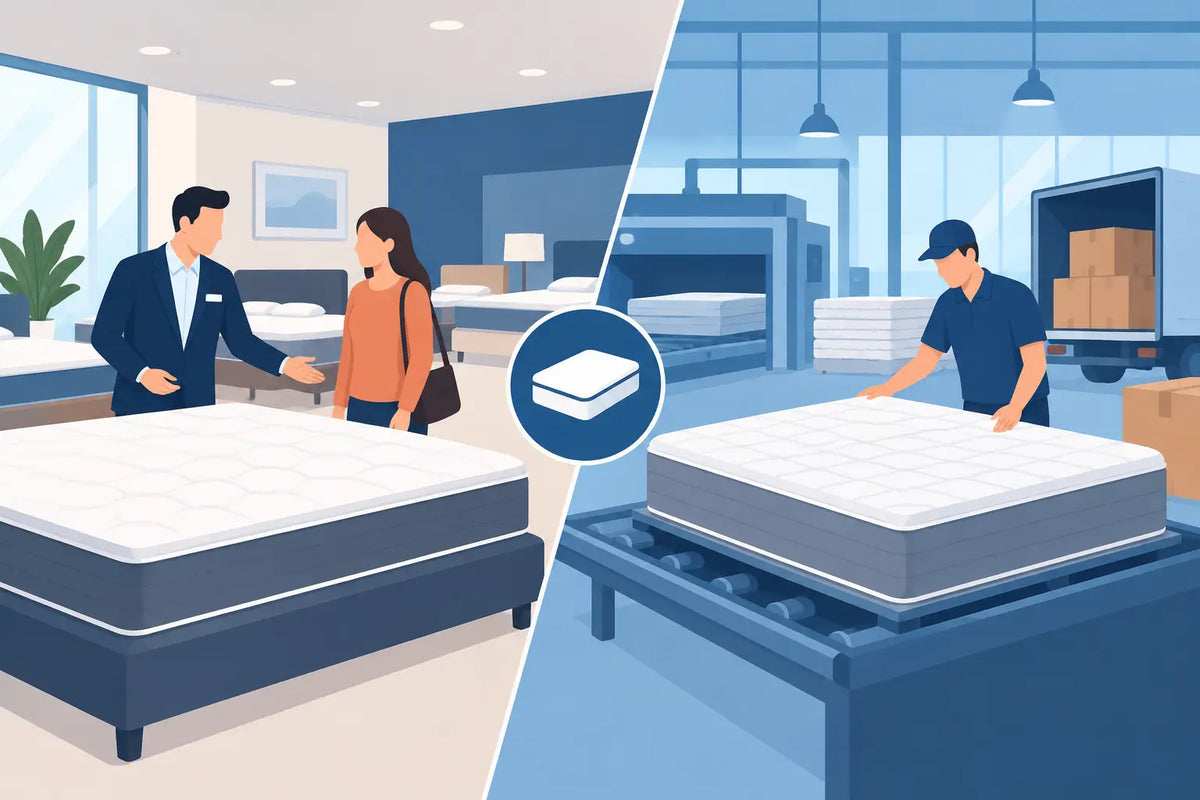
A mattress can look almost identical in a showroom and online listing yet be made, priced and specified in completely different ways. The question of retailer vs factory direct mattresses is not simply about finding the lower price. It is about knowing who chose the materials, who built the mattress, who can alter its dimensions, and who answers when something is not right.
For a straightforward UK standard size, either route can work well. For an antique bed frame, a boat berth, a very tall sleeper or a couple with different comfort needs, the difference can be far more practical.
Retailer vs factory direct mattresses: the basic difference
A mattress retailer sells products made by one or more manufacturers. It may operate online, from a high street shop, or through a large showroom. The retailer selects a range, sets promotions and handles the sale, but it does not necessarily make the mattress it is selling.
A factory-direct manufacturer makes the mattress and sells it to the customer without the usual retailer layer. In the best cases, the same business controls the design, sourcing, cutting, upholstery, assembly and sale. That gives it more direct knowledge of what is inside the bed.
Neither label automatically tells you whether a mattress is good. A retailer can stock excellent products, and a factory can make a poor one. The useful question is simpler: can the seller clearly explain the construction and take responsibility for it?
Where the price difference comes from
Retail prices have to cover more than the mattress itself. Depending on the business, they can include wholesale margins, showroom rent, sales staff, warehousing, advertising and frequent promotional campaigns. None of these costs is inherently improper, but they can make the ticket price a weak guide to the materials and labour inside.
Factory-direct pricing removes some of those layers. That may mean a lower price for a comparable specification, or it may allow more of the budget to go into pocket springs, natural fillings, deeper upholstery or hand finishing. It does not mean every direct mattress is cheap. A properly built mattress using wool, cashmere, horsehair, coir or latex still has real material and skilled labour costs.
Be wary of permanent discounts in either channel. If a mattress is always half price, the crossed-out figure is not especially useful. Compare the final price with tangible details: spring type and count, fillings, mattress depth, cover, border construction, tufting and guarantee length.
Compare the build, not the name
Mattress names are often designed to sound reassuring rather than informative. Terms such as “luxury”, “premium” and “orthopaedic” do not provide a standardised description of support or quality. In particular, “orthopaedic” has no formal medical standard in mattress retail.
A meaningful product description should say whether the mattress uses open-coil or pocket springs, foam, latex or a hybrid construction. It should identify the fillings where possible and state the finished dimensions. If the product has a spring count, check the size to which that count applies. A count quoted for a king size is not directly comparable with one quoted for a single.
Choice: broad range or a bed built around you
Retailers are useful when you want to try several brands in one place or narrow down a broad market quickly. A good retailer may also have experienced staff who can explain the feel of different models. The limitation is that the range is usually fixed. You choose from the sizes, depths, firmnesses and fabrics already offered by each supplier.
Factory-direct buying is particularly useful where the bed itself sets the specification. A frame measuring 122 cm by 190 cm is not a small double, and forcing a standard mattress into it creates gaps, overhang or an awkward fit. A manufacturer with its own production can make a mattress to the exact width, length and depth required, rather than asking you to adapt the bed to the catalogue.
That matters beyond unusual frames. A taller person may need extra length to avoid feet pressing into the footboard. A heavy-build mattress may need a more substantial spring unit and deeper construction. A low-profile frame may need a controlled mattress depth so it does not make the bed impractically high.
Custom work is not magic, though. Bespoke dimensions normally mean the mattress is made specifically for you, so returns may be treated differently from standard products. Measure the internal bed frame at several points, not just the old mattress. Check for inward-facing bolts, curved corners, side rails and lifting mechanisms before placing an order.
What factory ownership can change
When a manufacturer owns the production process, changes are easier to discuss in practical terms. You can ask for a non-standard length, a particular depth, a firmer feel, or a construction suited to a slatted base. The answer should be based on how the mattress is actually made, not on what stock happens to be in a warehouse.
It can also improve traceability. If a mattress is hand assembled in the maker's factory, the business should be able to describe the spring unit, upholstery layers and final finish without passing the question through several companies.
This is especially relevant for natural materials. Wool, cashmere, horsehair, cotton, coir and latex all behave differently. Wool helps manage moisture and contributes to a comfortable, breathable surface. Latex is resilient and pressure-relieving. Coir is firm and supportive. These are useful characteristics, not guarantees of a particular feel. Layer thickness, tension, springs and the sleeper's weight all affect the finished mattress.
Delivery, trial periods and the details after checkout
Buying direct does not have to mean waiting weeks with no information. Some standard foam and hybrid mattresses can be rolled for quicker delivery, while hand-finished pocket sprung or made-to-measure products need appropriate production time. The important point is that the stated lead time matches the product you are buying.
A retailer may offer quick delivery because it holds stock. That is helpful when a mattress is urgently needed. A factory-direct maker may offer more control over the specification, but a made-to-order product cannot always leave the next day. Decide which matters more before you order.
The same applies to trial periods, guarantees and returns. Read the conditions rather than relying on the headline. Ask whether the trial applies to all constructions and all sizes, whether a mattress protector is required, how collection works, and whether made-to-measure products are excluded. A guarantee usually covers manufacturing faults, not a change of preference or gradual softening from normal use.
For UK buyers, fire safety is another point worth checking. Mattresses sold for domestic use should meet the relevant furniture and furnishings fire-safety requirements. A responsible seller should be clear about testing and compliance rather than treating it as an optional extra.
How to choose the right route
A retailer makes sense if you value seeing several brands at once, want a readily available standard size, or have found a model whose full specification is clear. It can be a sensible route, particularly if the retailer gives straightforward information and realistic delivery terms.
Factory direct is often the stronger option if you need a non-standard size, want to understand the components in detail, or would rather pay for the mattress than layers of retail overhead. It is also worth considering when you need a specific construction, such as a hand-tufted natural-filling mattress, a two-tier pocket spring design, or a heavy-build model with support matched to the people using it.
Before choosing either route, establish five facts: the exact internal dimensions of your frame, the support system beneath the mattress, the sleepers' preferred feel, any issue such as overheating or partner movement, and the maximum finished height that will suit the bed. Those answers will narrow the field faster than a showroom label ever will.
The right mattress is not the one with the most dramatic saving or the grandest name. It is the one whose size, materials and construction are clearly stated, properly made and suited to the bed you already own. If your requirements fall outside the standard chart, start with the measurements - they are more honest than marketing.