
Pocket Sprung Mattress Benefits Explained
A mattress can feel excellent for five minutes in a showroom and quite wrong after a fortnight at home. The real pocket sprung mattress benefits show up over a full night: when you turn over, when your partner gets up first, and when your hips and shoulders need support in different places.
Pocket springs are not a miracle ingredient, and a high spring count does not automatically make a better bed. They are, however, a sound starting point for a mattress that responds to your body rather than asking your body to adapt to it. The quality depends on the spring unit, the fillings above it, the depth of the mattress and whether the finished feel suits you.
What is a pocket sprung mattress?
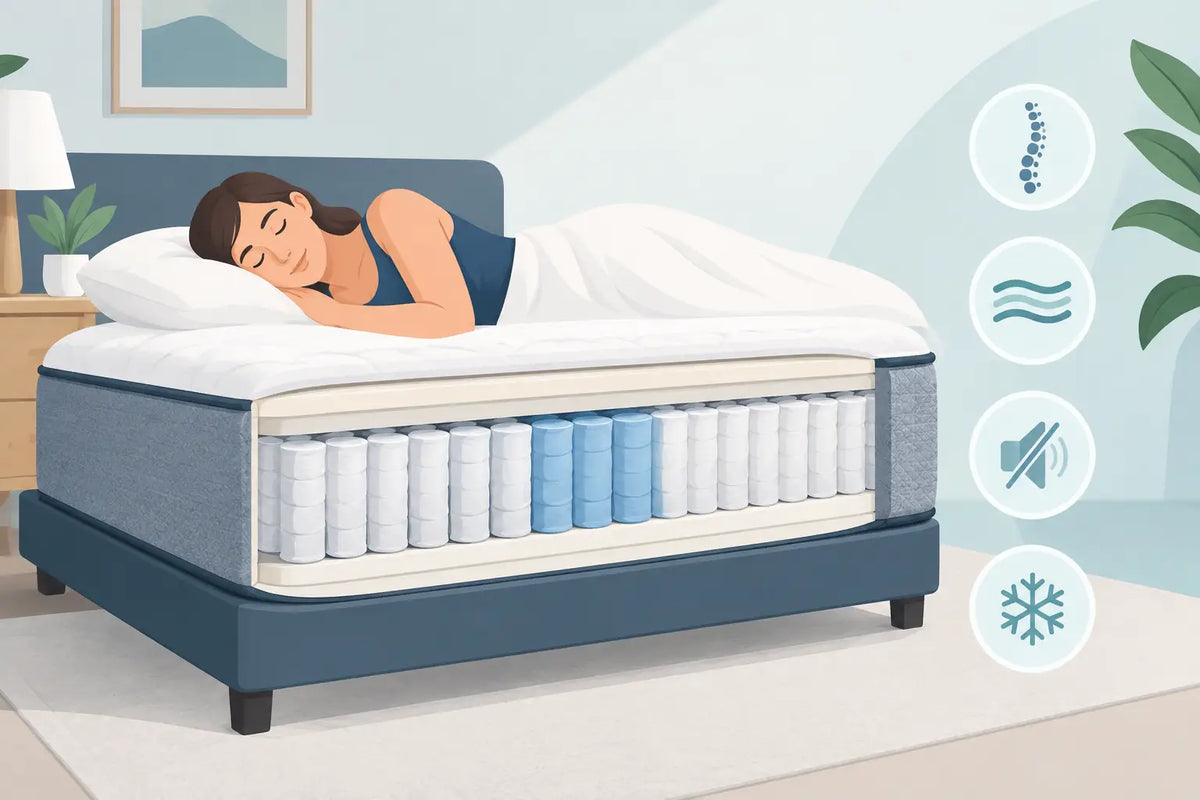
A pocket sprung mattress contains individual coil springs, each enclosed in its own fabric pocket. Because the springs are not tied together in one continuous unit, they can compress more independently. Put pressure on one area and the nearby springs are less likely to move with it.
This differs from a traditional open-coil mattress, where the springs are connected by wires. Open-coil designs can offer good value and are useful in some lighter-use situations, but their movement is more collective. Pocket springs are generally better at following the shape and weight distribution of the person lying on them.
Above the spring unit sit the comfort layers. These may include foam, wool, cotton, cashmere, horsehair, coir, latex or other materials. That is why two pocket sprung mattresses with the same stated spring count can feel completely different. Springs provide the support structure; the upholstery largely determines the immediate comfort, temperature and surface feel.
The main pocket sprung mattress benefits
Support that responds across the bed
Your shoulders, waist, hips and legs do not put equal weight into a mattress. A pocket spring unit can react in smaller zones than a connected spring system, allowing more give where the body is heavier while maintaining support elsewhere.
For side sleepers, this can be particularly useful around the shoulder and hip. For back sleepers, the aim is usually a steadier, more even feel through the pelvis and lower back. Neither position automatically requires soft or firm. The correct choice depends on body weight, preferred sleeping position and how much cushioning sits over the springs.
It is worth being plain about the word “orthopaedic”, which has no formal mattress standard behind it. A mattress should be chosen for comfort and support, not a vague badge. If back pain is persistent or severe, seek clinical advice rather than treating a mattress as medical equipment.
Less disturbance from a sleeping partner
Independent springs can reduce the transfer of movement across the mattress. If one person changes position or gets out of bed, the other is less likely to feel the whole surface shift.
This is one of the most practical benefits for couples, particularly where one partner is a light sleeper or keeps different hours. It will not remove all movement - the comfort layers, bed base and even a loose headboard can contribute to what you feel - but a well-made pocket sprung mattress usually behaves more quietly and locally than a basic connected-spring model.
For couples with very different comfort preferences, the answer is sometimes a split construction rather than a compromise firmness. A made-to-measure mattress can be built to suit an unusual frame, while some larger beds can accommodate separate mattresses with different feels. The best route depends on the frame and whether the join between two mattresses would be bothersome.
Better airflow than a solid foam core
Springs leave open space inside a mattress. This encourages air to move through the structure as you change position, rather than relying solely on the breathability of the top layers. Natural fillings such as wool, cotton, horsehair and coir can add further moisture management and ventilation.
That does not mean every pocket sprung mattress sleeps cool. A deep layer of heat-retaining foam can still create a warmer feel, and a waterproof protector will change airflow at the surface. If you regularly overheat, look beyond the label. Check the upholstery materials, mattress depth and the type of protector you use.
Useful support across a wider range of body weights
Pocket springs are available in different tensions, heights and arrangements. This gives manufacturers more scope to build a mattress for lighter sleepers, average-weight couples or people who need a sturdier, deeper construction.
A heavier person does not simply need the firmest mattress available. An excessively hard surface can feel uncomfortable at the shoulders and hips, while an underbuilt one may lose its comfort too quickly. What matters is a spring unit and comfort layer combination that resists bottoming out while still providing enough surface cushioning.
Heavy-build designs may use firmer springs, deeper fillings or multiple spring layers. These are practical construction choices, not marketing shortcuts. Ask about the materials and build rather than accepting a generic “extra firm” description at face value.
Spring count matters, but it is not the whole story
Mattress advertising often treats spring count as though it were a league table. It is only one specification. A higher count can mean smaller springs and a more finely responsive feel, but it does not tell you the wire gauge, spring tension, upholstery quality or how well the mattress has been assembled.
A modest-count, properly tensioned spring unit with substantial natural fillings can be a more satisfying long-term mattress than a high-count model with thin comfort layers. Likewise, a mattress with two spring layers may offer a different kind of depth and response, but it is not automatically right for every sleeper.
Look for useful facts: the mattress depth, spring type, stated tension, filling materials, whether it is single- or double-sided, and the recommended base. These details tell you more than a large number printed on a ticket.
Pocket sprung versus hybrid mattresses
A hybrid mattress usually combines a pocket spring unit with foam, latex or both. The term itself is broad, so it is not a guarantee of any particular quality or feel.
Choose a more traditional pocket sprung mattress with natural upholstery if you prefer a breathable, resilient surface with a slightly more buoyant feel. A hybrid may suit you if you enjoy the close contouring of foam or the springy pressure relief of latex while still wanting the support and airflow of springs beneath.
The trade-off is simple. More foam can provide pronounced cushioning and pressure relief, but some sleepers find it warmer or less easy to turn on. Natural fillings tend to have a different, often more breathable character, but they may require a larger budget and can make the mattress heavier to move.
The bed base is part of the decision
Even a well-built pocket sprung mattress needs appropriate support underneath. A solid platform top divan, a suitable slatted base or a properly supported bespoke frame can all work, provided the gaps and construction meet the mattress maker’s recommendations.
Wide slat gaps can allow the mattress to settle unevenly. An old bed frame with a sagging centre rail can make a new mattress seem faulty when the issue is actually below it. For antique frames, boat berths and non-standard sizes, measure the internal space carefully in several places, not just the nominal size of the bed.
A made-to-measure mattress is useful when standard UK sizes leave gaps, overhang the frame or simply do not fit. At Cadar Beds, dimensions can be specified to suit the bed rather than forcing the bed to suit the mattress. That matters for comfort as well as appearance: a mattress that shifts around is not a restful one.
How to choose the right feel
Start with how you sleep, not the firmness label. Side sleepers often appreciate more pressure relief at the shoulder; back sleepers may prefer a more level, supportive surface; front sleepers commonly need to avoid a mattress that lets the hips sink too far. Couples should consider the heavier sleeper as well as the lighter one, since the same mattress can feel firmer or softer to each person.
Then consider the filling. Wool-rich upholstery often offers a breathable, gently cushioning feel. Latex is elastic and quick to recover. Memory foam gives slower contouring. Coir creates a firmer, more structured layer. None is universally best.
Finally, think about ownership. Some mattresses are designed to be rotated, while double-sided models may be turned as well as rotated to spread wear. Follow the care guidance for the specific mattress, especially during the first few months. Use a protector, keep the bed base in good order and allow the mattress to air when changing sheets.
The sensible choice is not the mattress with the boldest claim or the biggest spring number. It is the one built with a support system, fillings and dimensions that make sense for the person sleeping on it and the bed it has to fit.