
Open Coil Mattress Construction Explained
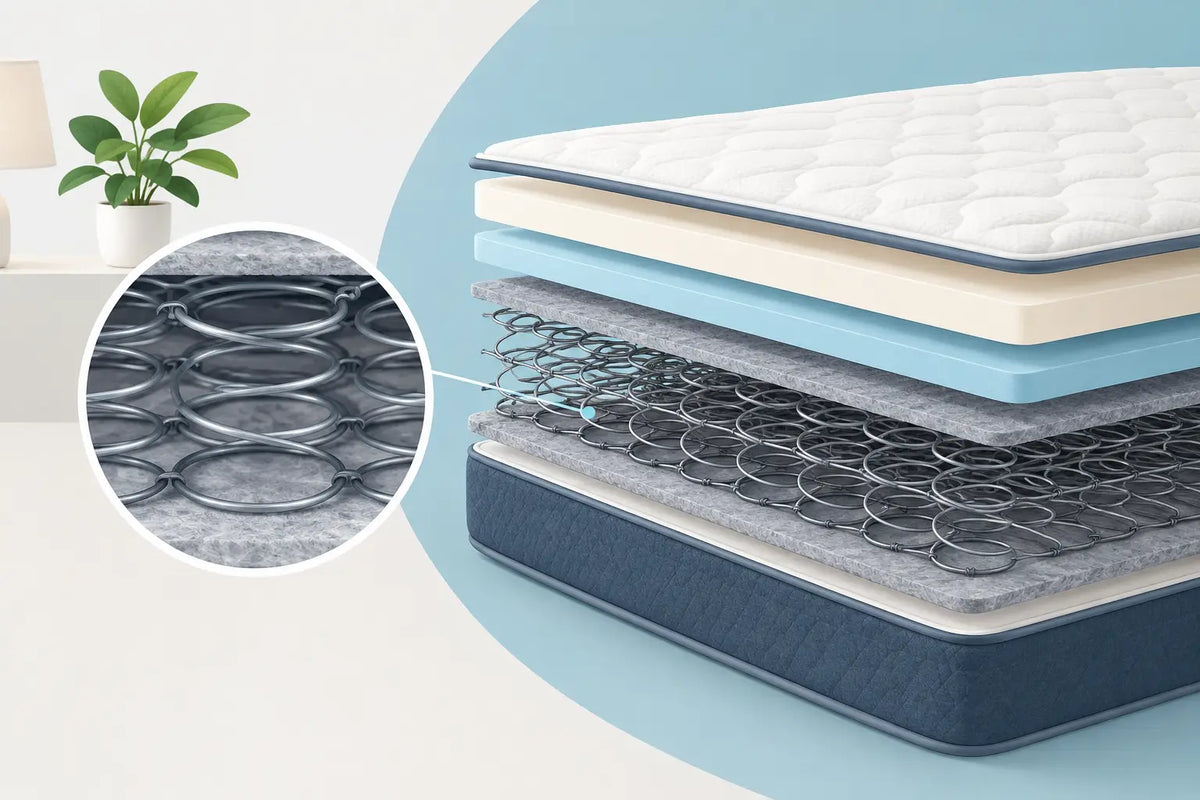
A low price does not automatically mean a poor mattress, and a complicated specification does not automatically mean a good one. Open coil mattress construction is a straightforward, long-established way to build a sprung mattress. When it is made properly, with sensible comfort layers and a supportive frame, it remains a practical choice for guest rooms, children’s beds and occasional use.
The useful question is not whether open coil is fashionable. It is whether its construction suits the bed, the sleeper and the job it needs to do.
What is open coil mattress construction?
An open coil mattress has a spring unit made from rows of hourglass-shaped metal springs connected together. The springs are usually joined with helical wires, creating one linked structure across the mattress. Push down in one area and the surrounding springs respond too.
You may also see this described as a Bonnell spring unit. In everyday mattress retailing, the terms are often used loosely. Strictly speaking, a Bonnell unit uses separate, interconnected coils, while a continuous coil unit is formed from a single length of wire shaped into rows of springs. Both create a linked, open-spring feel rather than the independent response of pocket springs.
That distinction is worth knowing, but it should not become a distraction. In either case, the key characteristic is shared movement. The spring unit works as a whole, rather than as hundreds or thousands of individually wrapped springs.
How an open coil mattress is built
The spring unit is the load-bearing core, not the complete mattress. Around it, a manufacturer adds layers that affect initial comfort, insulation and longevity. The quality of those layers has a real bearing on how the finished mattress feels.
A typical open coil construction begins with the spring unit and a perimeter support system, often a border rod. The border helps the mattress keep its outline and improves stability when sitting near the edge. Insulator pads are then placed over the springs to reduce the chance of feeling the coils through the surface. Comfort fillings, such as polyester fibre, foam, cotton or other upholstery layers, sit above those pads beneath the cover.
The cover may be quilted, where the fabric and fillings are stitched together for a flatter finish, or tufted, where tapes pull the upholstery through the mattress to hold it securely in place. Tufting can help control settlement in deeper, more traditionally upholstered models. It does not, by itself, tell you whether the mattress will be firmer or better made.
The finished depth can vary considerably. A shallow open coil mattress may be designed for a trundle bed or a child’s first bed. A deeper model with more substantial upholstery can feel noticeably more forgiving. Always look beyond the overall depth, though. A very deep mattress can still contain modest comfort layers.
Spring gauge, count and tension
Spring count is an easy number to advertise, which is why it is often overemphasised. For open coil units, the thickness of the wire, the coil shape, the number of turns, the unit height and the upholstery all matter. A higher count is not a universal measure of support.
Wire gauge is one useful indicator. Lower gauge numbers generally mean thicker wire and, all else being equal, a firmer, more resistant spring. Yet the final feel still depends on the build above it. A firmer spring under generous soft fillings may feel medium at first, while a lighter unit with thin padding may feel hard.
Tension labels need the same common-sense treatment. Firmness is not medically standardised across the mattress trade. One maker’s medium can be another maker’s firm. Body weight, sleeping position and personal preference all change the result.
What an open coil mattress feels like
Because its springs are connected, an open coil mattress tends to give a broad, even response. Many people describe the sensation as traditionally sprung: supportive across the surface, with a little bounce and less contouring around the body than memory foam or pocket springs.
For a single sleeper who changes position regularly, that can be perfectly comfortable. The open structure also allows air to move through the spring unit, which can be useful for those who prefer a less enclosing feel than dense all-foam mattresses provide. Breathability still depends on the comfort layers and cover, so it is not a guarantee that every open coil model will sleep cool.
The trade-off is motion transfer. As the springs are linked, movement on one side can be felt on the other. Couples, especially lighter sleepers paired with a restless partner, will usually notice more disturbance than they would on a pocket sprung mattress. The same linked action means the mattress does not adapt as precisely to shoulders, hips and different body shapes.
Where open coil mattresses make sense
An open coil mattress is often a sensible fit for a spare room, a child or teenager’s bed, a rental property, or a bed used occasionally. It can offer dependable basic support at a lower cost because the spring unit is simpler to manufacture than a pocket spring system.
It may also suit buyers who prefer a firmer, more level surface and do not want the slow response of memory foam. For a lightweight child, a well-built open coil mattress can be entirely appropriate. There is no need to buy a highly complex mattress simply because it has an impressive-sounding specification.
For everyday adult use, the answer depends on the person and the build. A durable open coil mattress with adequate upholstery can work well for some single sleepers. However, if you share a bed, have prominent pressure points, wake with hip or shoulder discomfort, or need stronger edge stability and targeted support, pocket springs or a carefully chosen hybrid are often the better long-term option.
Heavier sleepers should be particularly careful with shallow, lightly upholstered open coil models. The concern is not the label on the mattress but whether the spring unit and fillings are specified to cope with regular load. A heavier-build mattress, with a suitable spring system and more substantial upholstery, is usually the more realistic choice.
What to check before buying
Ask for the facts that influence performance rather than relying on phrases such as “luxury support” or “orthopaedic”. The latter has no formal medical standard in mattress retailing. A useful specification should tell you the spring type, approximate spring count for the size, tension, mattress depth, filling materials, whether it is single or double sided, and the stated weight guidance where relevant.
Also check how the mattress will fit the bed frame. An open coil unit has a defined shape and needs consistent support underneath. Slatted bases should have suitably close, secure slats; widely spaced slats can allow the mattress to sag between them over time. A solid or platform top base changes the feel slightly, often making a mattress seem firmer.
If the bed is an unusual size, measure the internal sleeping area rather than assuming the frame follows a standard UK size. Antique frames, day beds, boats and built-in spaces frequently vary by several centimetres. A mattress that is forced into a frame can bow at the sides, while one that is too small can move about and leave uncomfortable gaps. Made-to-measure production is useful here because the spring unit and upholstery can be built around the actual dimensions rather than padded out to fit an approximate size.
Finally, check the care instructions. Most open coil mattresses are one-sided and should be rotated head to toe regularly, particularly during the first few months. A two-sided model can be turned as well as rotated, which may extend its usable life, but only turn it if the manufacturer says it is designed for that purpose.
Open coil versus pocket springs
The simplest comparison is this: open coil springs work together, while pocket springs work individually. Pocket springs can respond more closely to different parts of the body and reduce partner disturbance. They also give manufacturers more scope to combine different tensions or add zoned support.
Open coil construction is generally simpler and more economical. That can be an advantage when the mattress is not carrying the full demands of nightly shared adult use. It becomes less attractive when precise pressure relief, low motion transfer or tailored support is the priority.
Neither type should be chosen from the spring count alone. A properly specified mattress with honest materials is more useful than a large number printed on a label with no explanation of what sits above or around the springs.
At Cadar Beds, the practical starting point is always the same: choose the construction for how the bed will actually be used, then make sure the dimensions, tension and fillings match the people sleeping on it. For a spare bed, uncomplicated can be exactly right. For the bed you rely on every night, it is worth paying attention to the parts you cannot see as well as the comfort you feel in the first five minutes.