
Is a Memory Foam Mattress Right for You?
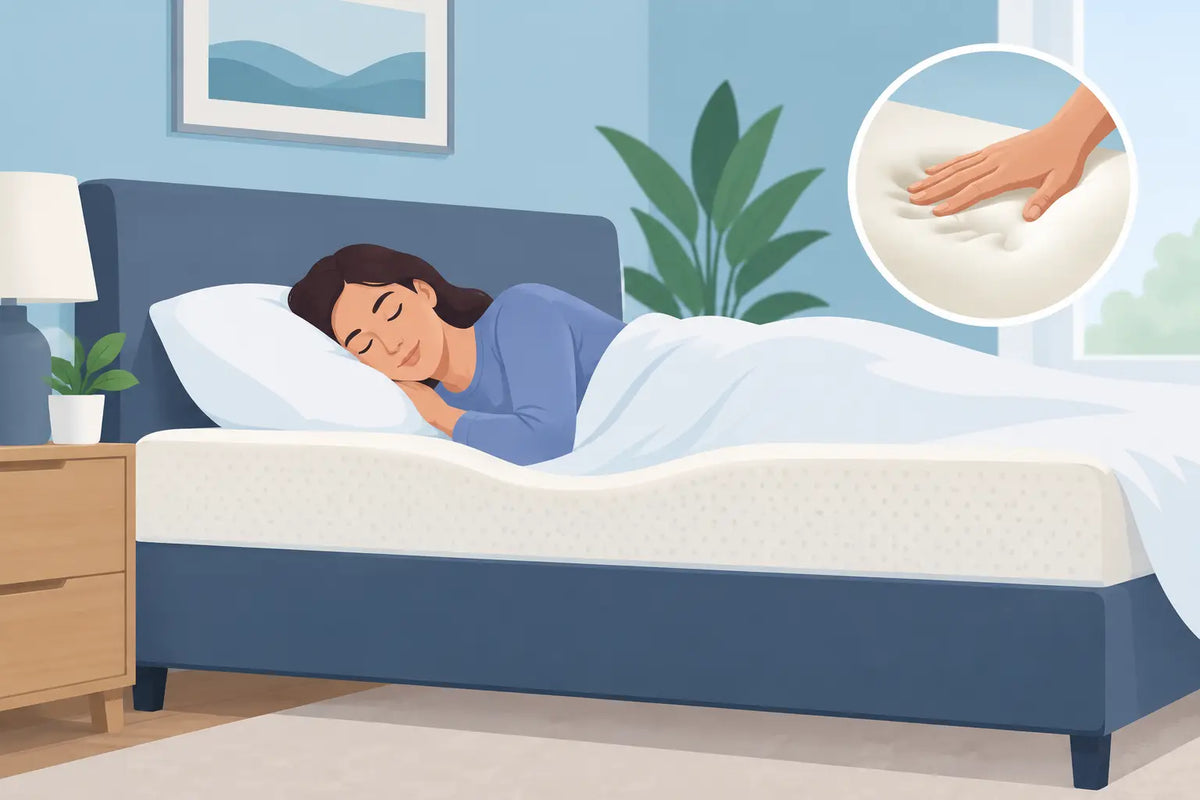
A memory foam mattress can feel like a relief after years on a tired, uneven bed. It spreads pressure across a wider area, cushions shoulders and hips, and usually limits the movement you feel when somebody turns over beside you. But the label alone tells you very little. Foam quality, layer depth, firmness, temperature control and the support beneath it decide whether the mattress feels comfortable for years or merely impressive for the first few nights.
What a memory foam mattress actually does
Memory foam is a pressure-responsive polyurethane foam. Under body heat and weight, it slowly softens and moulds around the body. When pressure is removed, it gradually returns to its original shape. That slower response is the defining characteristic: you sleep more in the mattress than on top of it.
For many side sleepers, this can reduce the sharp pressure that builds at the shoulder and outer hip. For couples, foam is also good at absorbing movement locally, so one person getting up is less likely to disturb the other. These are useful properties, not medical claims. A mattress cannot diagnose or cure back pain, and terms such as “orthopaedic” have no formal medical standard behind them.
The trade-off is feel. Some people enjoy the close, cradled sensation; others find it restrictive, especially if they change position frequently. If you prefer a buoyant, springy surface that responds as soon as you move, pocket springs, latex or a hybrid construction may suit you better.
Not all memory foam is the same
A low-priced foam mattress can contain memory foam, yet have very little of it, or use a thin comfort layer over basic support foam. That does not automatically make it unsuitable, but it should be priced and described honestly. Thickness is not proof of quality either. A very deep mattress filled with soft, low-density foam may lose its shape sooner than a slimmer one built with better materials.
The useful question is how the mattress is constructed from top to bottom. A sound design usually has a comfort layer for pressure relief, a transition layer to stop you sinking too abruptly, and a firmer core that carries your weight and keeps the sleep surface level. Covers, quilting and removable toppers can alter the initial feel, but they cannot compensate for inadequate support underneath.
Look for a clear account of the materials and the depth of each layer where available. Vague phrases such as “premium comfort system” are not specifications. Neither is a long list of branded foam names without an explanation of what each layer contributes.
Traditional, gel and open-cell foams
Traditional memory foam offers the deepest contouring and is often the slowest to respond. It can be very comfortable for pressure-sensitive sleepers, but may retain more warmth than other options.
Gel-infused memory foam incorporates gel particles or gel layers intended to reduce the sense of heat. Open-cell foam is designed with a more breathable internal structure. Both can help, but neither defeats physics: a close-fitting foam surface still holds more of your body heat than a naturally breathable wool or horsehair comfort layer. The cover, protector, duvet, room temperature and the mattress base all affect how warm you feel too.
If you regularly wake hot, do not buy on the strength of “cooling” printed on a label. Choose a construction with a breathable cover and consider a hybrid mattress with pocket springs, which allow more air to circulate through the core. A thinner memory foam comfort layer over springs can give pressure relief without the full heat and sink of an all-foam bed.
Choosing firmness without guessing
Firmness is personal, and the same mattress will not feel identical to two people. Body weight, sleeping position and personal preference all matter. A medium feel may suit an average-weight combination sleeper, while a heavier person may compress that same mattress too far and need a firmer support core. Equally, a very firm surface can create pressure points for a lighter side sleeper.
Your sleeping position provides a sensible starting point. Side sleepers generally need enough surface give for the shoulder and hip, while keeping the waist supported. Back sleepers often need a more even, stable feel that stops the pelvis dropping too deeply. Front sleepers usually benefit from a firmer, flatter surface, because excessive sink can leave the lower back overextended.
Couples with different builds need more thought than a single firmness label can offer. A compromise medium mattress is sometimes right, but not always. A pocket-sprung or hybrid design can provide more individual support, and some made-to-order mattresses can be built with different tensions on each side. That is more useful than expecting one person to tolerate a mattress that does not support them properly.
Support comes from the whole mattress
Memory foam provides comfort and contouring. It does not replace the need for a stable support system. In an all-foam mattress, that support comes from the higher-density foam core. In a hybrid, it comes largely from pocket springs below the foam. Each approach has a distinct feel.
An all-foam mattress is usually quieter, lighter to move and very effective at reducing partner disturbance. It can be a good practical choice for an upstairs room, a guest bed or a bed where a rolled mattress is useful. A well-made hybrid tends to feel more responsive around the edges and less enclosed, with springs doing more of the load-bearing work.
For a heavier build, pay particular attention to the support layer, edge stability and mattress depth. The answer is not simply “the firmer, the better”. A hard surface with no pressure relief can be uncomfortable, while a soft mattress that lets the hips dip is unlikely to last well. The aim is a level, supported posture with enough give at the contact points.
Heat, movement and the practical compromises
Every mattress type asks you to choose what matters most. Memory foam is among the best materials for motion isolation, so it is popular with light sleepers sharing a bed. It is also quiet and has no springs to creak. Against that, it can feel warmer and slower to move on than spring-led designs.
There is also the matter of edge support. Foam mattresses vary widely here. A firmer perimeter can make getting dressed or sitting on the bed easier and gives more usable space on a smaller mattress. If you sleep close to the edge, share a standard double, or find yourself sitting to put on socks, ask how the edges are built rather than assuming all foam behaves alike.
Give a new mattress time to settle. Rolled foam mattresses may need several hours, and sometimes longer, to fully expand after delivery. A faint new-material smell can occur when unpacked, particularly in a less ventilated room; airing the room and allowing the mattress to breathe normally resolves it. Any persistent or strong odour is a reason to contact the retailer rather than simply accepting it.
Measure the bed before choosing the mattress
A comfortable mattress that does not fit the frame is still the wrong mattress. Measure the internal space of an antique frame, day bed, cabin berth or custom platform in centimetres, taking account of corner posts, rounded ends and any inset ledge that reduces usable width. Do not rely solely on the name of the bed size, particularly with older furniture.
Standard UK sizes are convenient, but they are not a rule. A slightly longer mattress can make a material difference for a tall sleeper, while a shallow bespoke mattress may be needed for a raised bed frame or boat berth. The depth matters as well: a deep foam mattress may sit too high on a frame with a tall base, making it awkward to get in and out of bed.
At Cadar Beds, mattresses can be made to precise dimensions, including unusual widths, lengths and depths. For a non-standard frame, that avoids trying to force a standard mattress into a space it was never designed to fit. Check the required dimensions carefully before ordering, as a made-to-measure mattress is built for the measurements you provide.
A few buying checks worth making
Before committing, confirm the mattress’s stated firmness, total depth, construction and suitability for your base. A slatted base should have slats close enough together to support the mattress evenly; widely spaced slats can cause premature wear in foam. A sound platform top or suitable divan base is generally a straightforward match.
Also check the trial terms, guarantee length and fire-safety compliance. A sleep trial is useful because a few minutes in a showroom cannot reproduce a full night, but read what condition the mattress must be returned in and whether a protector is required. In the UK, mattresses supplied for domestic use must meet furniture fire-safety requirements. This is not an optional extra or a marketing feature.
Finally, separate comfort from gimmicks. Extra handles, a fashionable cover fabric or a dramatic product name are secondary to the materials, support and dimensions. A good mattress should explain plainly what it is made from, who it is likely to suit and where its compromises lie.
A memory foam mattress is a strong choice when pressure relief and reduced partner disturbance are high on your list. Choose it for the way it supports your body and fits your bed, not because the packaging promises a miracle. The right feel is the one you can settle into night after night, without having to persuade yourself that it will improve later.