
Mattress for Couples With No Motion Transfer
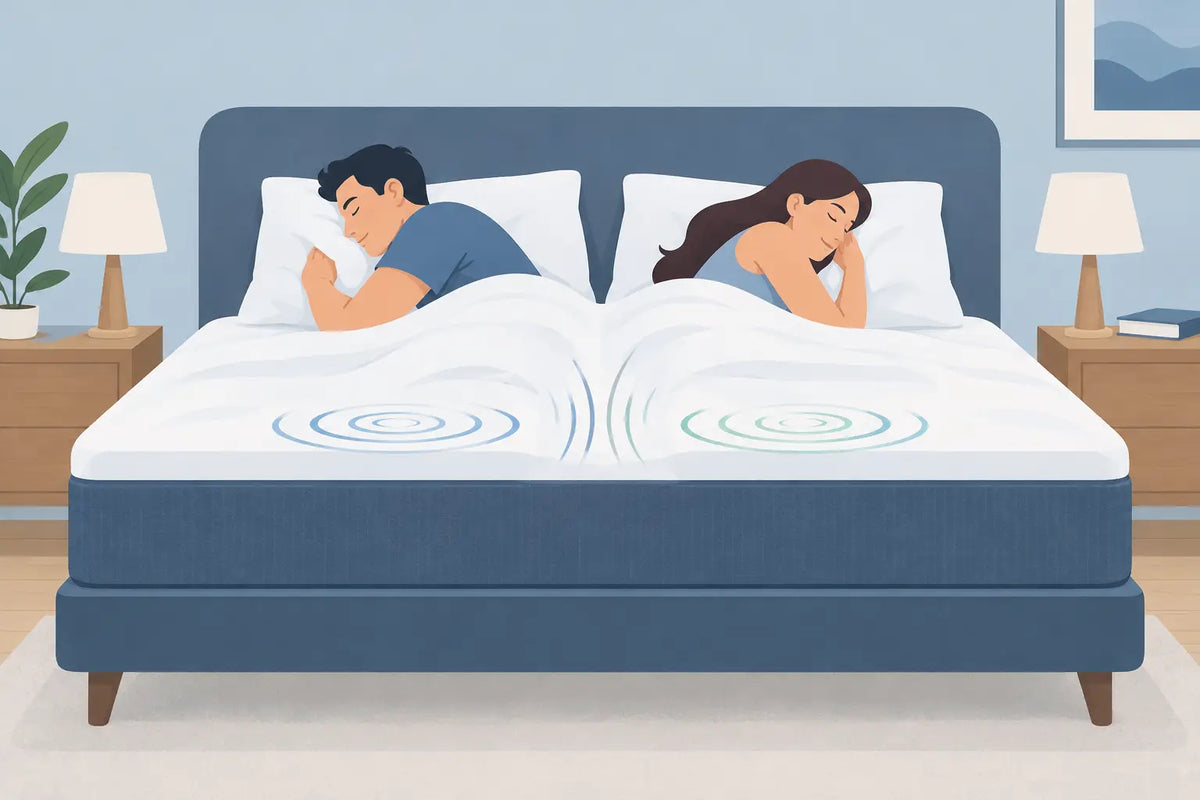
One partner gets up for work at 5am. The other has finally reached a deep sleep. If the mattress turns that simple movement into a ripple across the bed, both people start the day tired. A mattress for couples with no motion transfer is therefore not just about a softer feel or a fashionable material. It is about how the mattress is built, how much space you have, and whether its support suits two different bodies.
The honest answer is that no mattress removes every trace of movement. A person getting out of bed changes the load on any sleep surface. What a well-made mattress can do is contain that movement, so a turn, a late-night return to bed or an early alarm does not travel unnecessarily to the other side.
What causes motion transfer?
Motion transfer is the movement felt by one sleeper when their partner changes position. It is most obvious on mattresses where the internal support acts as one connected surface. Traditional open-coil mattresses use springs joined together by wire, so pressure applied in one area can influence a much wider area. They can be good value and perfectly suitable for some guest beds or occasional use, but they are rarely the first choice for light sleepers sharing a bed.
The bed base matters too. A worn slatted base with loose or bowed slats can add bounce, while an old divan base may no longer support the mattress evenly. Before blaming the mattress alone, check that the base is sound, level and appropriate for its weight.
Size has a practical effect that is often overlooked. Two adults on a standard double have 67.5cm of personal width each, less than a standard single mattress. Moving to a king size or super king gives each person more room to turn without encroaching on the other sleeper's area. It does not replace good motion isolation, but it makes a real difference.
The best mattress constructions for couples
Pocket springs isolate movement better than connected springs
In a pocket sprung mattress, each spring sits in its own fabric pocket. The springs can respond more independently than a linked open-coil unit, which limits the spread of movement across the surface. It also allows the mattress to support the shoulders, hips and lower back in a more localised way.
Spring count alone does not settle the question. It is regularly used as a headline number, yet the quality of the wire, the height of the springs, the arrangement of the unit and the comfort layers above it all matter. A higher count can be useful, particularly in a larger mattress, but it is not automatic proof of better support or better motion isolation.
For couples, a pocket sprung mattress with substantial comfort layers is often a sensible middle ground. It provides the responsive support many people prefer while reducing the bounce that makes a partner's movements more noticeable.
Memory foam is very effective, with a few trade-offs
Memory foam absorbs movement rather than transmitting it, which is why it is often one of the strongest options for partner disturbance. If one person turns over, the foam around them compresses and recovers locally. A good memory foam layer can be particularly useful where one partner is a restless sleeper or rises several times during the night.
The trade-off is feel. Some people like the close, pressure-relieving contour of memory foam; others find it slower to respond when changing position. Heat can also be an issue, especially with dense foams and a warm bedroom. Breathable covers, perforated foams, gel-infused foams and a pocket sprung core can help, but none turns foam into a naturally cool material. If you sleep hot, look at the whole construction rather than relying on a cooling label.
Hybrid mattresses balance containment and responsiveness
A hybrid usually combines pocket springs with foam, latex or other comfort layers. For many couples, this is the practical route: the spring unit gives support and easier movement, while the upper layers soften the feel and help dampen partner movement.
Not all hybrids are alike. One may use a slim foam layer over a basic spring unit; another may have deep, high-quality comfort layers and a more substantial pocket spring core. Ask what is actually inside, including layer depth, filling type and total mattress depth. Terms such as “luxury hybrid” say very little on their own.
Latex offers a different kind of pressure relief
Latex is naturally resilient and responds faster than memory foam. It tends to feel buoyant rather than deeply sinking, and quality latex can provide useful pressure relief with good airflow. It isolates movement well, though usually not quite to the same extent as a deep memory foam surface.
It can be a strong choice for couples where one person dislikes the slow recovery of memory foam but both want less disturbance. Latex mattresses are often heavier and can cost more, so consider whether the mattress needs to be turned, moved upstairs or fitted through a tight stairwell.
Firmness matters, but it cannot be chosen by a label
A mattress that is too soft for the heavier partner may allow their hips to dip, creating poor spinal alignment and greater movement when they reposition. A mattress that is too firm for the lighter partner can cause shoulder or hip pressure, leading to more tossing and turning. That is why a single “medium firm” label is not a universal solution for couples.
Body weight, sleeping position and personal preference all affect the right feel. As a broad guide, side sleepers often need enough cushioning around the shoulder and hip, while back and front sleepers commonly need a flatter, more stable surface. Heavier sleepers may need firmer support or a heavy-build construction that is designed to carry greater loads without premature sagging.
Where preferences differ sharply, compromise should not mean one person sleeps badly. A made-to-measure mattress can be built to the dimensions of an unusual frame, including wider sizes that give each partner more space. For some couples, two separate mattresses on a shared base are also worth considering, particularly in super king dimensions. This gives each person their preferred firmness and almost completely separates movement, though the join in the middle may not suit everyone.
Look beyond the mattress surface
A thick pillow-top can feel comfortable in a showroom, but its role in motion isolation depends on what lies beneath. Deep upholstery helps absorb small movements, yet the support core still determines how the mattress behaves under two bodies over time. Natural fillings such as wool, cashmere, cotton, horsehair and coir each have distinct properties: wool helps with moisture management, horsehair offers springiness, and coir adds firmer structure. They are not magic ingredients, but in a properly built mattress they can create a breathable, resilient sleep surface.
Hand tufting also deserves a plain-English explanation. Tufts secure fillings through the mattress, helping to control settlement and maintain a firmer, flatter feel. This can be valuable in a deep natural-filling mattress, although it may not suit someone seeking the softer, unbroken surface of a foam-topped design.
A mattress protector will not materially improve motion transfer, but it can protect the comfort layers from moisture and staining. Choose one that does not add unnecessary crinkling or heat, particularly if the mattress has a breathable natural-filling or latex surface.
How to choose without being distracted by marketing
Start with the problem you are trying to solve. If partner movement is the main issue, prioritise pocket springs, memory foam, latex or a carefully specified hybrid over an open-coil mattress. If one sleeper is much heavier, do not sacrifice structural support simply to gain a softer top layer. If space allows, consider increasing the bed width before spending more on elaborate features.
Then check the details a seller should state clearly: mattress dimensions, total depth, spring type, the materials in the comfort layers, whether it is single or double sided, its recommended base, and the weight it is designed to support. A trial period is useful, but it does not excuse vague specifications. You should know what you are buying before it arrives.
For non-standard frames, measure the internal ledge or platform where the mattress sits, rather than assuming the outside dimensions of an antique frame tell the full story. A mattress made a few centimetres too wide can bow at the sides; one made too short can slide and leave an awkward gap. Precise sizing improves both the fit and the usable sleeping area.
The right shared mattress should make your partner's normal movement less of an event, not promise impossible stillness. Choose the construction that suits both sleepers, give yourselves enough width, and insist on clear information about what is inside. Better sleep is usually built from those practical decisions, not from a dramatic label on a showroom ticket.