
Made to Measure Mattress for an Antique Bed
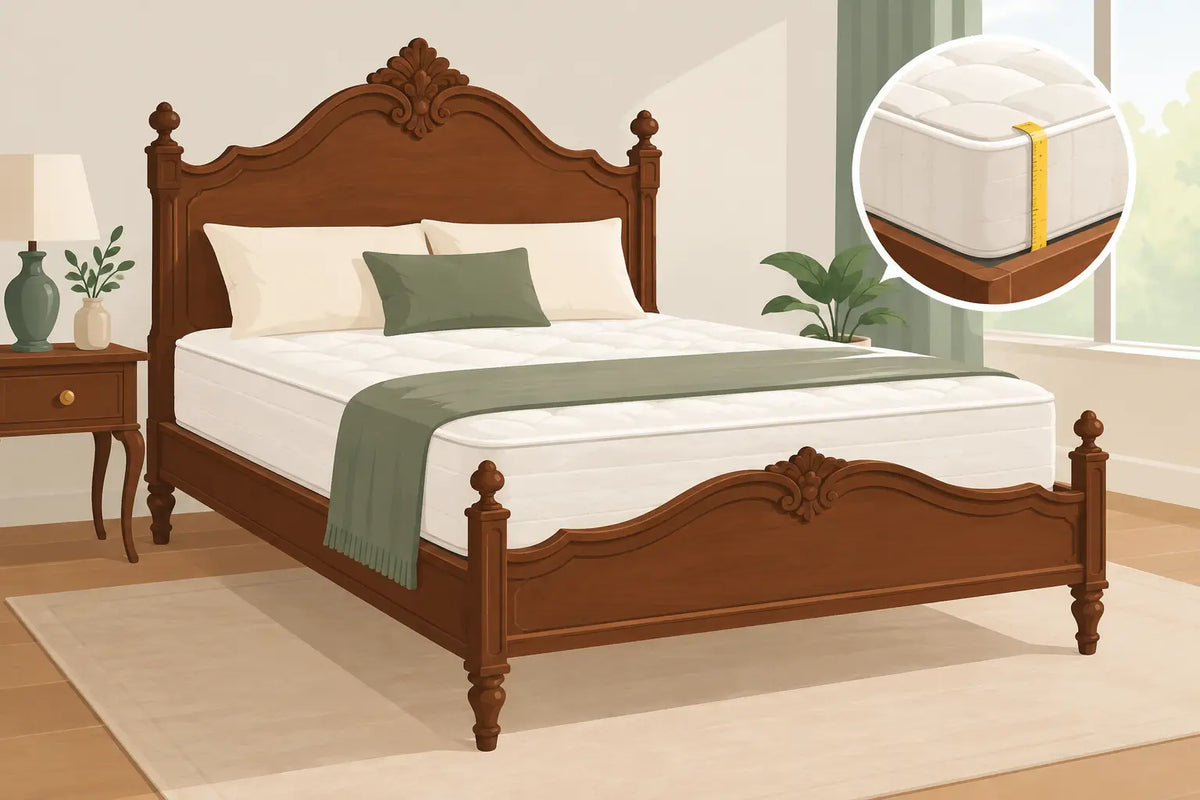
An antique bed can be beautifully made, solid enough to outlast several modern replacements, and still awkward to sleep on if the mattress does not fit. A made to measure mattress for an antique bed solves the practical problem without asking you to alter the frame, wedge in foam, or settle for a standard size that leaves visible gaps.
The right mattress should respect both parts of the bed: the proportions of the original frame and the needs of the person sleeping in it. That means measuring carefully, choosing a sensible depth and specifying a construction that delivers proper support - not merely filling an unusual space.
Why antique beds need a made to measure mattress
Older bed frames were not built around today’s standard UK mattress sizes. Even when a frame is described as a double, king or single, its internal dimensions may differ by several centimetres. Some were made before dimensions became more consistent; others were produced by local makers, imported from Europe, or altered during restoration.
A standard mattress that is slightly too small can move around, expose the slats and spoil the look of the bed. One that is too large may bow at the sides, sit on top of the rails or put pressure on a delicate frame. For an antique bed, forcing a mattress into place is rarely a sensible fix.
A bespoke size also gives you control over length. Many antique bedsteads are shorter than a modern mattress, while some continental frames are wider or longer than their nearest UK equivalent. Made-to-measure production lets you order the dimensions the frame actually requires, rather than trying to make a nominal size work.
Measure the inside of the frame, not the old mattress
The old mattress is useful evidence, but it should not be your final reference. It may have shrunk, softened at the edges or been the wrong size from the beginning. Measure the internal space where the new mattress will sit.
Take the width and length at several points, particularly on a wooden frame that may not be perfectly square. Use the narrowest width and shortest length as your working measurements. This avoids a mattress that catches on the rails or needs to be compressed into the bed.
For most frames, allowing a small clearance around the mattress is sensible. A little room makes fitting and removing bedding easier and prevents rubbing against the bedstead. The correct allowance depends on the frame: a metal bed with straight internal rails behaves differently from a carved wooden frame with an irregular inner edge.
Also check for obstructions. Bed bolts, corner blocks, curved rails and decorative internal mouldings can reduce the usable space. If the base has slats, inspect their spacing and condition. A quality mattress cannot compensate for slats that are cracked, widely spaced or poorly supported at the centre.
Do not overlook mattress depth
Depth matters as much as width and length. A thick mattress can hide an attractive headboard, sit too high above the side rails or make it difficult for shorter sleepers to get in and out of bed. Conversely, a very shallow mattress may leave the sleeper sitting too low within a deep frame.
Measure from the slats or base to the top of the side rail, then consider the finished height you want. If the rails are low, a deeper mattress may need more of its profile held below rail level to remain secure. If the rails are high, a lower-profile design can preserve the bed’s proportions.
There is no universal “correct” depth for an antique frame. The best choice depends on rail height, the type of base, how the bed is used and the comfort construction you prefer.
Choose the construction for your sleep, not the age of the bed
An antique bed does not require an old-fashioned mattress. It needs one that fits correctly and works with its base. Your comfort needs should still lead the specification.
A pocket sprung mattress is often a strong all-round choice. Individual springs react more independently than an open-coil unit, which can help reduce movement transfer when two people share the bed. Pocket springs can be paired with foam, wool, cotton, cashmere, horsehair, coir or latex depending on the feel and temperature control you want.
Memory foam can suit sleepers who want closer pressure relief around the shoulders and hips. It is not automatically the best answer for back pain, despite what some advertising suggests. The right firmness, support level and sleeping position matter more than a fashionable label.
Latex is naturally responsive and has a more buoyant feel than slow-moving memory foam. Natural fillings such as wool and horsehair can help with moisture management and create a traditionally upholstered feel, particularly in hand-tufted mattresses. These materials are not just there for a romantic product description - they have distinct handling, resilience and comfort characteristics.
For a lighter-use guest bed or a tighter budget, an open-coil mattress may be appropriate. For a daily-use bed, especially one shared by two adults, the additional support and motion isolation of a well-built pocket sprung or hybrid design is often worth considering.
Match the mattress to the base
Many antique beds use slats, but their design varies greatly. Closely spaced, firm slats provide a more stable platform than widely spaced or flexible slats. A sprung edge mattress may behave differently on an old slatted base than it would on a divan, so the base should form part of the decision.
If your antique frame has a solid platform, ventilation becomes more relevant. Mattresses need airflow beneath them to help manage moisture. A breathable construction and regular airing are useful, but neither substitutes for a sound, well-ventilated base.
Where a frame is structurally delicate, avoid assuming that a heavier mattress is always better. Natural fillings, deep spring systems and hand tufting can add considerable weight. The trade-off may be worthwhile, but check the frame, centre support and slats can carry it safely.
Firmness is personal, even in a bespoke size
A made-to-measure mattress is not automatically a custom comfort prescription. Size, firmness, fillings and construction are separate choices, and they should be considered that way.
Body weight, sleeping position and personal preference all affect what feels supportive. Side sleepers often need enough surface cushioning at the shoulder and hip. Front sleepers usually benefit from avoiding an overly soft surface that allows the pelvis to sink too far. Back sleepers can suit a range of feels, provided the mattress keeps them comfortably supported rather than simply feeling hard.
Be wary of the word “orthopaedic”. It has no formal medical standard in the mattress industry. A mattress described that way is not a clinical guarantee, and firmer is not always healthier. The useful question is whether the construction and firmness suit the person who will use it night after night.
Couples with different preferences have choices, though each involves a compromise. A medium feel can be a practical middle ground. Alternatively, a split construction can offer different tensions on each side, but it may introduce a join that some sleepers notice. The dimensions of the antique frame may also limit what is practical.
Details that protect the bed and the mattress
An antique bed is worth protecting from avoidable wear. Use a properly fitted mattress protector, particularly if the mattress includes natural upholstery layers that should remain dry and clean. A protector is easier to wash than a mattress cover and can extend the useful life of the bed’s main comfort layers.
Turn or rotate the mattress according to its construction. Some are designed to be rotated only; double-sided designs may be turned as well. Do not turn a one-sided mattress simply because an older mattress required it. Follow the instructions for that particular build.
When fitting the mattress, lift rather than drag it across painted rails, polished wood or cast-metal edges. Bespoke mattresses are made to fit closely, and a little care at this stage protects both the frame and the fabric cover.
What to expect when ordering a made to measure mattress for an antique bed
A good bespoke service should make the dimensions clear before you buy. You should be able to enter width, length and, where offered, depth or mattress model choices, then see the price update without submitting a quote request or waiting for a sales call.
At Cadar Beds, mattresses are made in-house rather than selected from a retailer’s standard warehouse range. That matters for unusual dimensions because the size is built into the production process, not treated as an inconvenient exception. It also allows the mattress construction to be chosen for the sleeper and the base, whether that means pocket springs, latex, memory foam or natural fillings.
Before placing the order, write down the internal bed dimensions, rail height, base type and any feature that narrows the usable space. If the bed is valuable or unusually shaped, photograph and measure it twice. A made-to-measure mattress is a straightforward answer to a non-standard bed, but accuracy at the measuring stage is what makes it work.
A well-fitted mattress lets an antique bed remain what it was meant to be: a bed you use, not a piece of furniture you have to work around.