
Latex vs Pocket Spring Support for Better Sleep
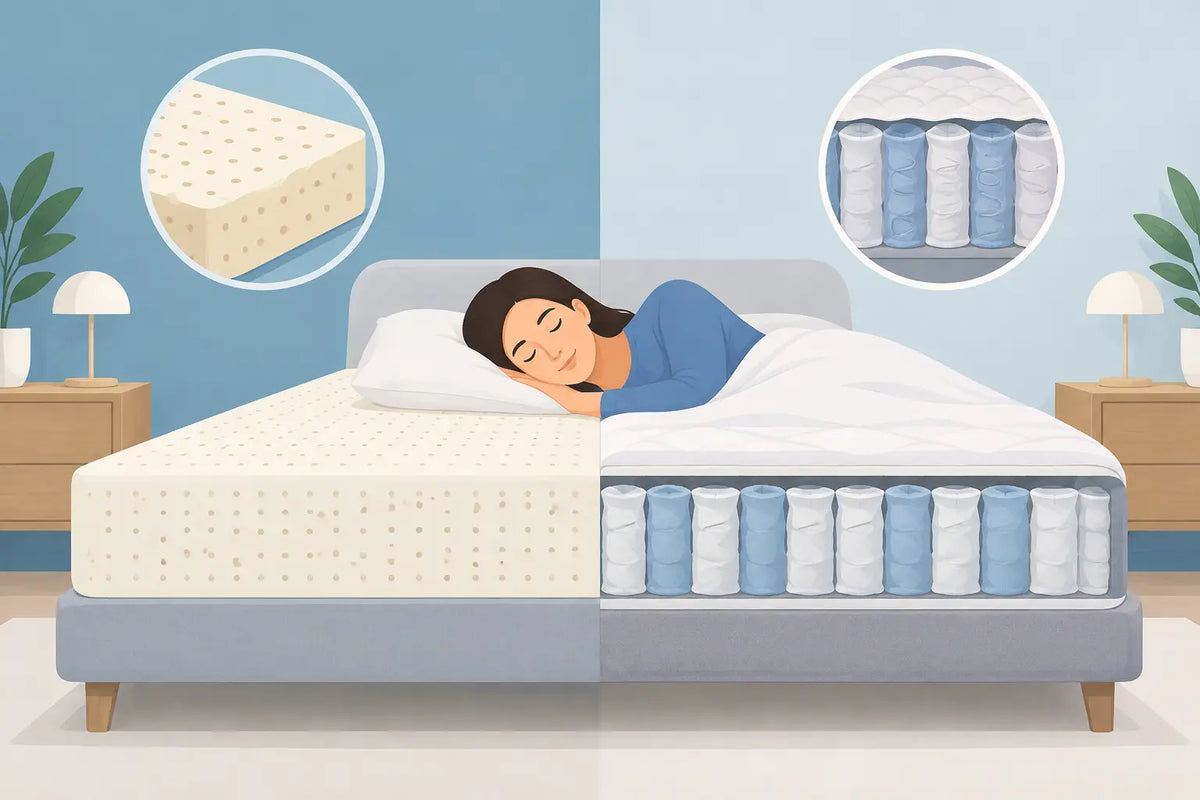
A mattress can feel soft at first and still provide poor support after a few hours. That is why latex vs pocket spring support is not simply a choice between a bouncy mattress and a foam-like one. The real question is how the mattress holds your body in a neutral, comfortable position, night after night, at your weight and in your preferred sleeping position.
Both materials can make an excellent mattress. Both can also be used badly. A thick layer of quality latex and a well-built pocket spring unit work very differently, so it helps to understand what each part is doing before choosing a firmness label or spring count.
What mattress support actually means
Support is the mattress's ability to keep your spine reasonably aligned while allowing wider, heavier areas such as shoulders and hips to settle in. It is not the same as firmness. A firm mattress may resist your body strongly but create pressure points. A softer mattress may initially feel comfortable yet allow your hips to sink too far.
In a traditional mattress, the spring unit usually supplies the main structural support. Comfort fillings then moderate the feel on top. In an all-latex mattress, latex takes both roles: it carries the sleeper and provides cushioning. In a hybrid, pocket springs form the core while latex is commonly used as a comfort layer.
This distinction matters. When comparing mattresses, ask what the core is made from, how deep it is, and what sits above it. Marketing terms such as “orthopaedic” do not describe a regulated construction standard. The materials and build tell you far more.
Latex vs pocket spring support: the practical difference
Latex responds through compression. Press into it and the material pushes back, spreading load across a wider area. Pocket springs respond individually: each fabric-wrapped spring compresses according to the pressure placed on it, while nearby springs can remain comparatively undisturbed.
Neither is automatically better. Latex gives a broad, buoyant support that many people describe as sleeping "on" rather than "in" the mattress. Pocket springs offer more localised give, particularly where shoulders, hips and different body weights need different levels of response.
How latex supports the body
Quality latex is elastic, durable and naturally springy. It contours without the slower, sinking feel associated with memory foam. When you turn over, it recovers quickly, which can suit combination sleepers who do not want to feel held in one position.
A firmer latex core can provide very substantial support, including for heavier sleepers. The important detail is its density and thickness. A thin latex layer over a weak foam core is not a latex support mattress, whatever the label suggests. It is a foam mattress with a latex comfort layer.
Latex can be made using different processes and blends. Natural latex usually has a denser, weightier feel and may have small visual variations. Blended latex combines natural and synthetic rubber. Neither description alone confirms overall mattress quality, but the proportion, depth and position of the latex should be stated clearly.
How pocket springs support the body
Pocket springs are individual coils enclosed in fabric pockets and joined together. Unlike an open-coil unit, they can move more independently. That helps the mattress follow the body's shape and can reduce the effect of one partner moving during the night.
Spring count matters, but not in isolation. A high count in a king size mattress can indicate smaller springs, two layers of springs, or simply a particular way of counting. Wire gauge, spring height, coil design, zoning and the quality of the surrounding upholstery all change the result. A mattress with fewer, properly specified springs can be more supportive than one making an impressive number its main selling point.
Pocket springs are particularly useful where two people have different weights. Each side of the bed can respond more independently than a single uniform block of material. For couples, that often feels more forgiving than a very firm all-foam construction.
Pressure relief and sleeping position
Side sleepers usually need enough surface cushioning for the shoulder and hip. Latex is very good at distributing pressure while retaining a responsive feel. A pocket sprung mattress can achieve the same result when it has suitable comfort layers, whether those are latex, wool, cotton, cashmere or other upholstery materials.
Back sleepers tend to need steadier support through the lumbar area without excessive hip sink. A medium to medium-firm pocket sprung mattress often works well, but body weight and build remain more useful guides than a generic firmness category. A supportive latex core can also be an excellent choice, particularly for those who prefer a more even, springy surface.
Front sleeping places different demands on a mattress. Excessive softness can allow the pelvis to drop, which may put the lower back in an awkward position. A firmer pocket spring unit or firmer latex construction is generally the more sensible starting point. That does not mean choosing the hardest mattress available. It means avoiding deep, uncontrolled sink.
Movement, heat and mattress feel
Pocket springs generally offer stronger isolation than interconnected springs, but latex also handles movement well because it responds locally and recovers quickly. If partner disturbance is a major concern, look at the whole construction. A pocket spring core with thick latex or foam comfort layers will often absorb movement more effectively than a very shallow upholstered spring mattress.
Latex has an open-cell structure and is often perforated, allowing air to move through it. Pocket sprung mattresses also ventilate well because air can circulate around the springs. Natural fillings such as wool can help manage moisture and temperature, although no mattress can guarantee that every sleeper will stay cool. Room temperature, bedding, duvet weight and individual physiology all play a part.
Feel is where the two choices become most obvious. Latex has a smooth, lifted resilience. Pocket springs usually feel more traditionally upholstered, with a little more depth and local flexibility. A hand-tufted pocket sprung mattress with natural fillings will feel very different from a rolled hybrid with a shallow spring unit, even though both use pocket springs.
Durability depends on the build, not the label
Latex has a strong reputation for longevity, and deservedly so when it is thick enough and properly supported. It resists permanent body impressions better than many lower-density foams. However, it is heavy, and an all-latex mattress may be less convenient to move, rotate or fit through a tight stairwell.
Pocket springs can last for many years when the springs, upholstery and edge support are properly made. The weak point is not necessarily the spring unit. It may be inexpensive fillings above the springs that compress first, altering comfort before the core has failed.
For a mattress intended for a high sleeper weight, a larger bed, or everyday use by two adults, look beyond the headline material. Ask about mattress depth, the type of spring unit, filling layers, edge construction and whether the mattress is designed to be turned or rotated. These are practical signs of how seriously a mattress has been built.
Made-to-measure beds need a little more planning
A non-standard bed frame should not force you into a compromise on support. Whether the mattress is for an antique frame, a boat berth or an unusually long bed, the internal construction can be specified for the size rather than cut down from a standard product.
With very wide mattresses, pocket springs have a particular advantage because the unit can support each sleeper across a large surface. Latex can also work well, but the weight of a deep all-latex mattress becomes significant in oversized dimensions. Consider how often it will need rotating and whether the base beneath it has adequate, evenly spaced support.
At Cadar Beds, mattresses are made to order, which makes it possible to match the internal build as well as the width, length and depth. For bespoke work, precise measurements and a clear discussion of sleeper weight, position and preferred feel are more valuable than choosing from vague comfort labels.
Which should you choose?
Choose latex if you want responsive pressure relief, a buoyant feel and a mattress with little of the slow sink associated with memory foam. It is especially worth considering for combination sleepers and anyone who values a clean, even sleeping surface.
Choose pocket springs if you prefer a more traditional mattress feel, want individually responsive support across the bed, or need a construction that can be tailored through spring tension and natural upholstery. They are a sensible choice for couples, particularly where body weights differ.
For many people, the most balanced answer is not either-or. A pocket spring core with a meaningful layer of latex combines independent support with resilient pressure relief. The key word is meaningful: a token-thin comfort layer will change the marketing description more than the way the mattress performs.
Before ordering, lie down if you can, or assess the specification with the same care you would give a sofa or a pair of walking boots. Your mattress does not need the biggest spring number or the trendiest material. It needs to support your body, fit your bed properly and still feel right after the first ten minutes have passed.