
Hybrid vs Memory Foam Mattress: Which Suits You?
A mattress can be labelled “hybrid” and still feel completely unlike another hybrid. That is why the useful question is not simply hybrid vs memory foam mattress, but what is actually inside it, how thick each layer is, and how those materials will suit the people sleeping on it. A good label is not a specification.
Memory foam mattresses and hybrids can both provide excellent pressure relief and partner-friendly comfort. Their differences are most noticeable in the way they respond when you move, how much airflow they allow, and whether you prefer the stable, moulded feel of foam or the livelier support of springs.
Hybrid vs memory foam mattress: the basic difference
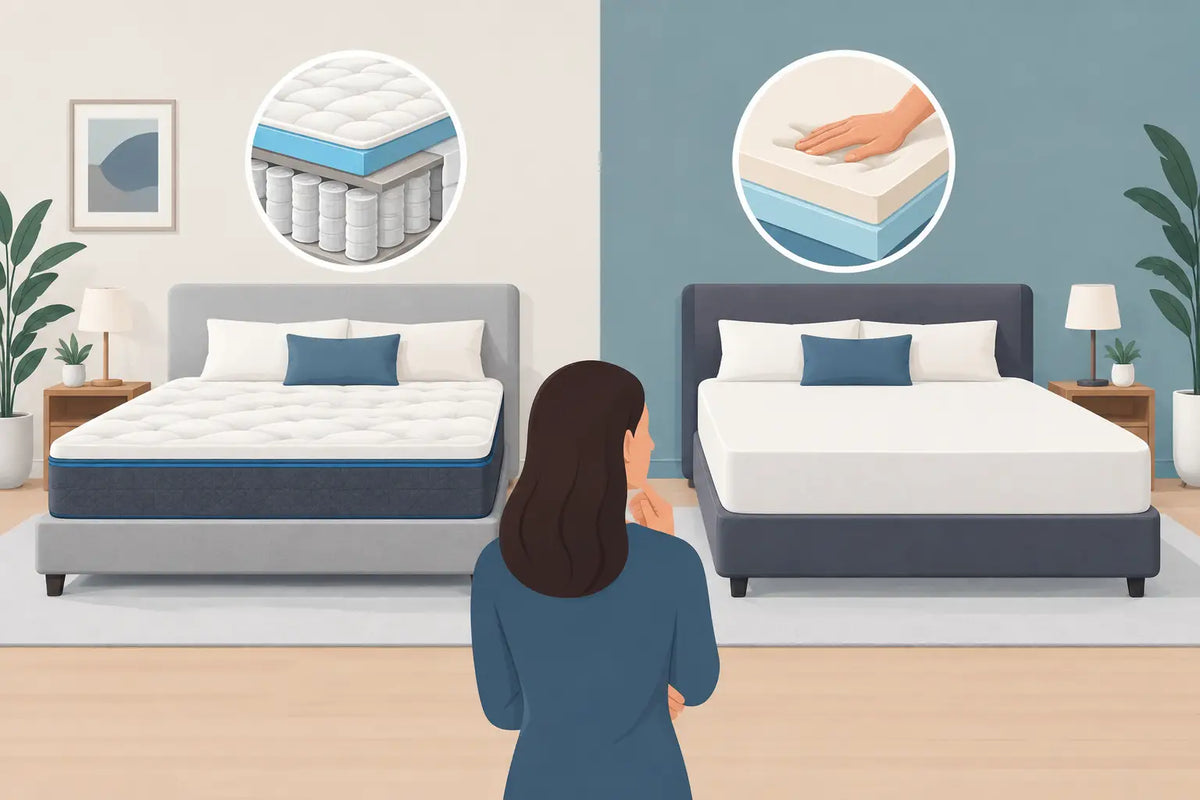
A memory foam mattress is usually built from several foam layers, with memory foam near the surface and a firmer support foam beneath. Memory foam reacts to body heat and pressure, gradually contouring around the shoulders, hips and legs. It spreads your weight across a wider area, which can make it a sensible choice for sleepers who dislike pressure building at prominent joints.
A hybrid mattress combines a spring unit with comfort layers. In most worthwhile hybrids, that means individually pocketed springs topped with foam, latex, natural fillings, or a combination of these. The springs provide the main support structure; the upper layers determine much of the initial comfort and pressure relief.
The word “hybrid” is used rather freely. It does not automatically mean a mattress is better made, cooler or more supportive. One model may have a deep pocket spring unit and substantial comfort layers, while another may contain a shallow spring layer beneath a thin sheet of foam. Ask what type of springs are used, how many there are, and what sits above them. Those facts tell you far more than the headline.
Feel and pressure relief
Memory foam has a slower response. When you settle into it, it creates a close, cushioned feel and reduces the immediate sensation of lying on a flat surface. Many side sleepers appreciate this, particularly where the shoulder and hip need room to sink in without forcing the spine out of line. It can also suit anyone who enjoys the feeling of being gently held by the mattress.
That same close contouring is not for everyone. Some people find that dense memory foam makes changing position feel less effortless, especially if they sleep warm or have reduced mobility. The feeling varies considerably between foams, too. Density, firmness, layer depth and cover construction all matter. “Memory foam” alone does not tell you whether a mattress will be soft.
A hybrid generally gives a more buoyant surface feel. Pocket springs push back independently, while the comfort layers take the edge off that support. For combination sleepers, this often means easier movement through the night. A hybrid with memory foam on top can still offer good pressure relief, but it tends to feel less enveloping than an all-foam mattress because the spring unit adds lift beneath you.
Neither construction is automatically best for back pain, hip pain or a particular sleeping position. Mattress labels such as “orthopaedic” have no formal medical standard. The better aim is straightforward: choose a mattress that keeps your spine in a comfortable, neutral position and does not create excessive pressure at your shoulders or hips.
Support comes from construction, not a firmness label
Firmness describes how a mattress feels at the surface. Support describes whether it holds your body evenly. These are related, but they are not the same thing.
A well-made memory foam mattress needs a substantial, durable support core. If the base foam is too soft or too thin for the sleeper using it, the mattress may feel comfortable at first yet allow the pelvis to sink too far. Conversely, a firmer foam core with a pressure-relieving top layer can give a balanced result for many sleepers.
In a hybrid, the spring unit does much of the structural work. Pocket springs are individually housed, allowing them to respond more locally than a traditional open-coil unit. This can be useful where two people have different weights or sleep close together. For larger body types, a deeper or higher-count spring unit, combined with suitable upholstery, may provide a more stable long-term feel than a light hybrid designed mainly for occasional use.
There is no universal rule that heavier sleepers must choose the firmest mattress available. A very hard sleeping surface can create pressure points and poor comfort. What matters is a construction that does not bottom out under the sleeper, with enough comfort material to cushion the body properly.
Heat, airflow and the reality of “cooling” claims
Memory foam has a reputation for sleeping warm because it conforms closely to the body and can reduce airflow around the sleeper. That reputation has some basis, particularly with thick, dense foam layers and non-breathable covers. Gel infusions and phase-change fabrics may alter the initial feel, but they do not turn every foam mattress into a cool-sleeping one.
Hybrids often allow more air to move through the spring unit, so they can feel fresher than a similar-depth all-foam mattress. This is not a guarantee. A hybrid topped with a very deep layer of dense memory foam may still retain warmth, while one using breathable fibres, wool, latex or more responsive foam can feel noticeably less close.
If overheating is a regular problem, look beyond marketing terms. Consider the thickness of memory foam, the presence of an open spring core, the breathability of the cover and protector, and your duvet and bedding. The mattress matters, but the whole bed affects temperature.
Movement, edge support and sharing a bed
All-foam mattresses are usually strong at reducing partner disturbance. Foam absorbs much of the movement created when someone turns over or gets out of bed. For light sleepers sharing with a restless partner, that quiet, settled feel can be a real advantage.
Pocket-sprung hybrids can also isolate movement well, provided the springs are properly pocketed and the comfort layers are substantial enough. They are usually less still than foam, but far more controlled than basic interconnected spring mattresses. If you prefer a responsive bed but do not want every movement transferred across the mattress, a quality pocket-sprung hybrid is often the middle ground.
Edges deserve attention, especially on a small bed or where one person tends to sleep near the side. Foam mattresses may use firmer perimeter foam, while hybrids may use reinforced springs or foam encasement. Neither method is inherently superior. What matters is whether the edge remains supportive when sat on or slept near, rather than collapsing into a slope.
Durability and practical ownership
Durability depends on the grade and depth of the materials, not whether the mattress arrives rolled in a box or carries a fashionable name. Lower-quality foams can soften and develop body impressions sooner. Lightweight springs can lose their resilience. A deeper mattress is not always better either, particularly if much of its height comes from low-density comfort foam.
Look for a clear account of the filling layers, spring type, mattress depth, recommended base and guarantee. If a mattress is one-sided, it should usually be rotated as instructed. Two-sided sprung mattresses may also be turned, which can help distribute wear, but only where the manufacturer specifically designs them for this. Do not assume every pocket-sprung mattress can be flipped.
For an unusual frame, the construction choice may come after the sizing question. An antique bed, a boat berth or a wall-to-wall platform can require a precise width and length. A made-to-measure mattress should not mean settling for a generic foam block cut to size. At Cadar Beds, spring systems and upholstery can be built to specified dimensions, so the comfort choice and the fit of the mattress can be considered together.
Which should you choose?
Choose memory foam if you want close contouring, strong motion isolation and a quieter, less springy feel. It is particularly worth considering if pressure relief is your main priority and you enjoy a mattress that responds slowly around the body.
Choose a hybrid if you want more bounce, easier movement, spring-led support and potentially better airflow. It is often a practical option for combination sleepers, couples with different preferences, and anyone who finds all-foam mattresses too enclosed.
The most useful final check is to ignore the broad category for a moment. Compare the actual layers, support unit, firmness, depth and intended user weight. Then consider your bed base, sleeping position, whether you share the bed and whether heat is an issue. The right mattress is the one whose construction answers those everyday questions honestly, night after night.