
How to Measure a Custom Mattress Properly
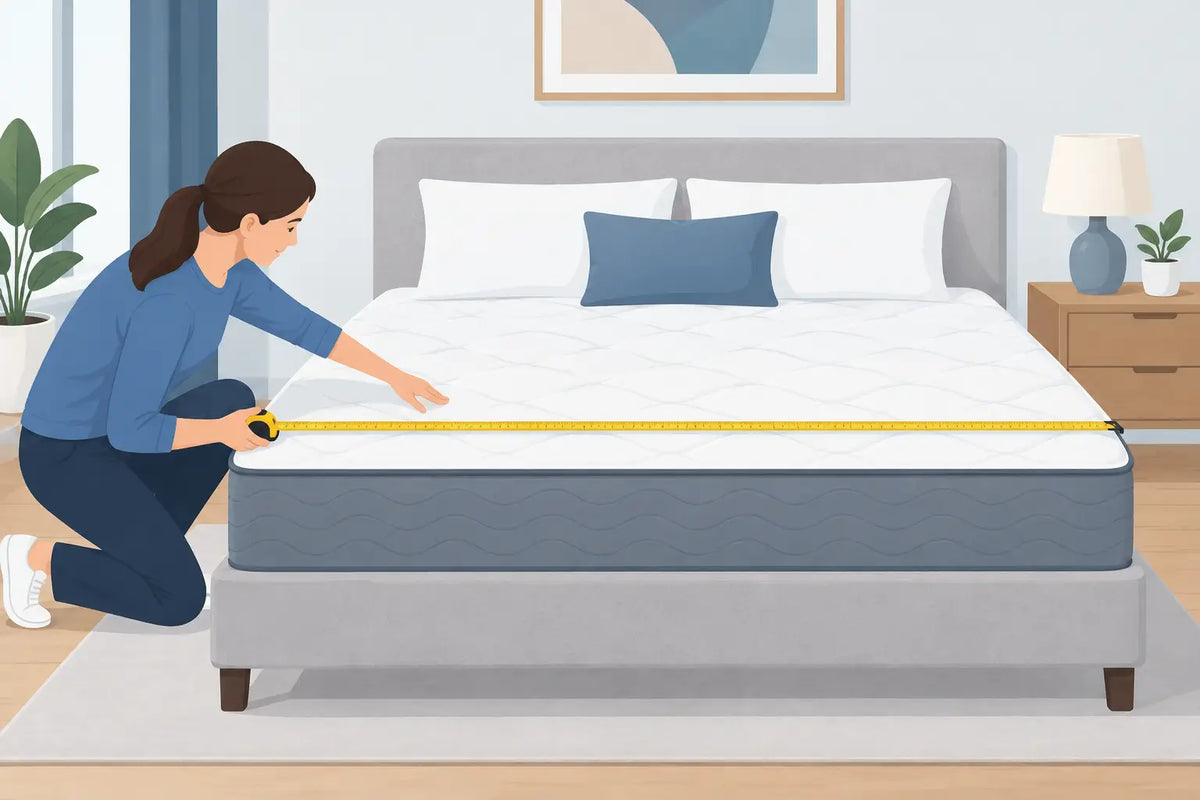
A mattress that is 2 cm too wide can bow at the sides, make a drawer base stick or leave you fighting fitted sheets. Too short, and it can creep away from the headboard each time the bed is made. Knowing how to measure a custom mattress properly is what turns an unusual bed frame, berth or alcove into a bed that fits as it should.
Do not measure an old mattress and assume its dimensions are right. Foam compresses, borders soften and handmade mattresses can change slightly over years of use. Measure the space the new mattress must occupy instead.
Start with the inside of the bed frame
For a conventional bedstead, take measurements from the inside edges where the mattress will sit. This sounds obvious, but it is the most common source of error. The outside measurement of a frame includes rails, posts and decorative edges, none of which tells you the usable mattress size.
Use a rigid steel tape measure rather than a fabric tape. Measure in centimetres and, where possible, record the final figure in millimetres. A custom mattress is made to a stated size, so “about four foot wide” is not enough when the actual internal width is 121.5 cm.
Measure the width at the head, centre and foot of the frame. Then measure the length down both sides and through the middle. Older bedsteads, handmade frames and boat berths are not always perfectly square. Write down every measurement rather than relying on the first one you take.
If all readings match, your required size is straightforward. If they differ, the smallest usable measurement is usually the one that matters. A mattress can have a little clearance around it; it cannot comfortably occupy a space that narrows in the middle.
Measure width, length and available depth
The three key mattress dimensions are width, length and depth:
- Width is measured from one inside side rail to the other.
- Length is measured from the inside of the head end to the inside of the foot end.
- Depth is the vertical space available for the mattress, particularly where there are side rails, drawers, a recessed platform or a lid that must close.
Measure from the slats, platform or sprung base to the top of the side rail. That tells you how much of the mattress will sit within the frame. There is no single correct amount, but many people prefer enough rail showing to keep the mattress neatly positioned without making it difficult to get in and out of bed.
Allow a small fitting tolerance
A made-to-measure mattress should fit closely, not be forced into place. For most square, rigid frames, allowing roughly 1 cm of clearance overall in both width and length is sensible. That might mean ordering a 149 cm x 199 cm mattress for a space that measures exactly 150 cm x 200 cm internally.
The right allowance depends on the bed. A fully upholstered frame may have soft sides that give slightly, while a painted wooden frame may have uneven rails or brackets that steal space at one point. A boat berth can change shape along its length, and a mattress in a narrow cabin needs enough room to be lifted out for cleaning.
Avoid adding a large gap “just in case”. A mattress that has 3 cm or 4 cm to move can shift during the night, expose the base and make bedding look untidy. The aim is a controlled fit, not a loose one.
Check what sits beneath the mattress
Before finalising dimensions, inspect the base. Slatted bases should have sound, evenly spaced slats and central support where the bed design requires it. A damaged or sagging base can make a new mattress appear to fit badly when the problem is actually underneath.
If the frame has inset support rails, measure at the level where the mattress will rest, not at the top of the frame. A bed can be wider above the rails than it is at the support point. The same applies to a recessed platform, where internal trim or corner blocks may reduce the usable area.
For adjustable beds, measure the existing mattress platform and check the manufacturer’s guidance on flexibility. Not every mattress construction is suitable for frequent bending. Pocket springs, foam and latex can be specified in ways that suit adjustable bases, but a heavy hand-tufted mattress with firm borders may not be the right choice.
Measuring an irregular shape or boat berth
A rectangle is easy. A mattress with a rounded end, angled corner or tapered side needs more information than a width and length.
First, make a full-size template. Brown paper, lining paper or several sheets taped together can work for simple shapes. For larger or more complex spaces, thin card, hardboard or a purpose-made template material is more reliable. Lay it flat where the mattress will sit, mark the edges carefully and trim gradually until it fits without curling or forcing.
Mark the template clearly. Include the head end, foot end, top surface, underside, any cut-outs and the position of angled corners. Write the longest length and widest point on it as a useful cross-check. Take photographs of the template in place before removing it.
For a tapered berth, measure the width at regular intervals along the length, such as every 25 cm or 50 cm. This helps confirm the shape even if a template is being supplied. Do not assume two angled sides are symmetrical. On boats and older fitted furniture, they often are not.
Curves, corners and obstacles
A curve should be traced, not guessed from a single radius measurement. Likewise, a corner cut-out for a ladder, cupboard, pipe boxing or bed post needs its exact location measured from two fixed edges. A cut-out in the wrong place by even a small amount may prevent the mattress from fitting.
If a mattress must pass through a narrow hatch, stairwell or cabin doorway, measure that route too. A large custom mattress may fit the berth but be difficult to manoeuvre into it once finished. Rolled delivery can help with eligible constructions, but the mattress type, depth and size all affect what can be rolled safely.
Do not copy an old mattress without checking
An existing mattress is useful as a reference, especially if it fits the frame well. Measure it at several points, but compare those figures with the bed itself. Its cover may be stretched, its corners rounded, or its border compressed. A 150 cm mattress that has settled to 148 cm does not mean the replacement should be 148 cm.
Also consider whether you want to change the depth or construction. Replacing a thin open-coil mattress with a deeper pocket sprung, latex or natural-filling model may improve comfort, but it changes the finished bed height. If you are adding a topper, include its depth in the calculation. The top of the sleep surface matters more than a specification on paper.
Record the specification before ordering
Make a final written note with the mattress width, length and preferred depth, along with the frame’s smallest internal measurements. Add whether the mattress needs square corners, rounded corners, a tapered end or cut-outs. This prevents the common problem of remembering the correct width but transposing the length, particularly on short beds and narrow berths.
It is worth checking standard UK sizes before choosing a bespoke dimension. A standard mattress is often the sensible route when the frame genuinely accommodates one, as bedding is simpler to buy and the choice is broader. But do not force a nominal double, king or super king into a frame that is a few centimetres different. Standard labels describe broad categories, not a universal fit across every old bed frame ever made.
At Cadar Beds, a made-to-measure size can be specified directly, with pricing updating as the dimensions are entered. That is useful, but it does not replace careful measuring. The factory can build accurately only from the dimensions you provide.
A final check before you commit
Measure again on a different day, ideally with someone holding the tape square and taut. Check width at three points, length at three points and the available depth from the actual support surface. If the frame is out of square, trace a template rather than hoping a rectangular mattress will settle into place.
A custom mattress is not complicated when the measurements are honest. Give the maker the real space, allow a sensible fitting tolerance and account for the bed base and delivery route. The result should feel made for the bed because it is - not because somebody persuaded it to fit.