
How to Choose Mattress Depth for Your Bed Frame
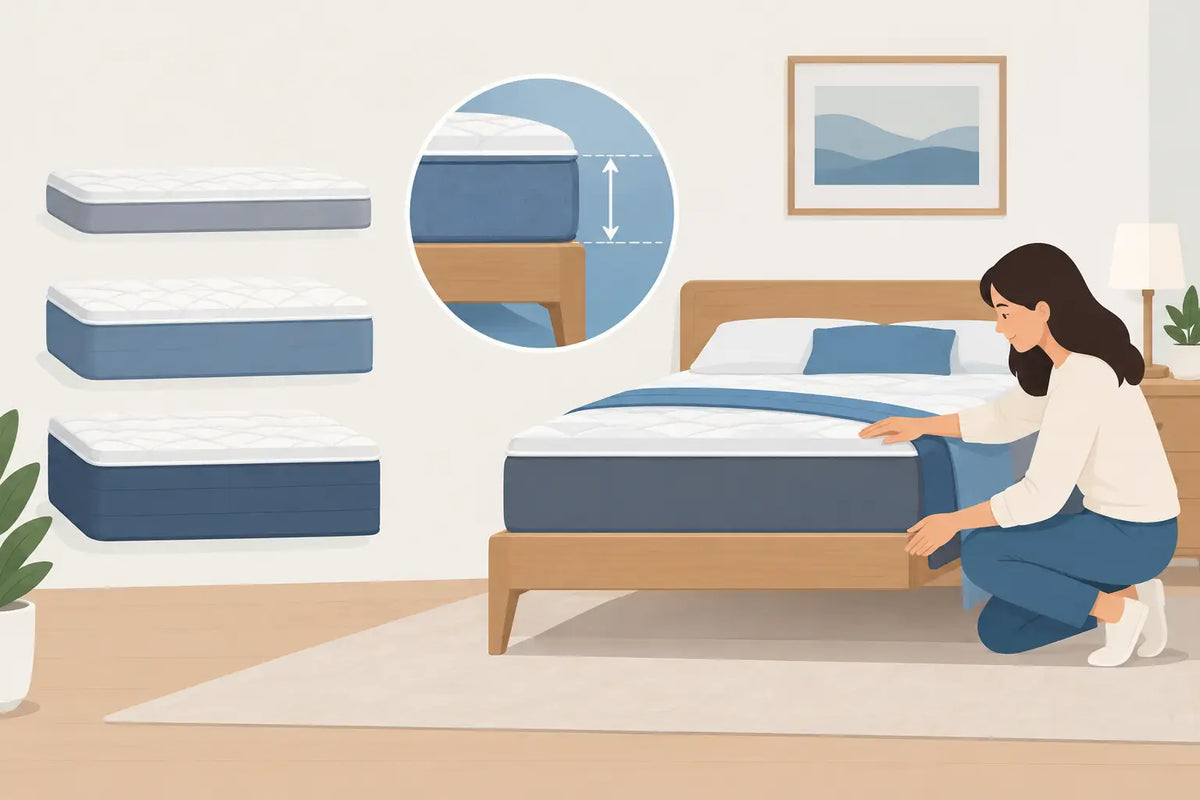
A mattress that looks right online can be awkward in the bedroom if it is the wrong depth. It may sit too high in an antique frame, make fitted sheets useless, or leave a shallow bed rail doing very little. Knowing how to choose mattress depth means looking beyond the mattress alone: the frame, sleeper, fillings and finished bed height all matter.
Mattress depth is not a shortcut to comfort or quality. A 30 cm mattress is not automatically better than a well-made 22 cm one. What matters is whether the construction has enough room for the spring system and comfort layers you need, while still fitting your bed properly.
What mattress depth actually means
Mattress depth is its height from the base to the top surface, normally measured in centimetres. It is sometimes called thickness, but depth is the more useful term when buying for a particular bed frame.
In practical terms, most adult mattresses fall somewhere between 18 cm and 35 cm deep. Slimmer mattresses are common for guest beds, children’s beds, trundles and spaces with limited clearance. Standard pocket sprung, memory foam and hybrid mattresses often sit around 22 cm to 30 cm. Heavy-build models with deeper spring units, substantial natural fillings or hand-tufted finishes can be deeper still.
The figure on the product specification should be treated as an approximate finished depth, especially with natural fillings. Wool, cotton and other loose comfort layers settle and respond to use. That is normal bedding behaviour, not a fault. A tightly compressed foam mattress tends to hold a more consistent profile than a traditionally upholstered one.
Start with the finished bed height
Before choosing a depth, measure from the floor to the top of the bed base or slats. Then add the proposed mattress depth. This gives you the height of the sleeping surface, which is far more useful than considering either measurement on its own.
A finished bed height that lets you sit on the edge with both feet comfortably on the floor will suit many adults. Taller people may prefer a higher surface; shorter people, children and anyone with restricted mobility may need a lower one. There is no universal correct height, but there is a clear wrong one if getting in and out of bed feels like a climb or a drop.
Do not forget the effect of a topper. A 5 cm topper on a 28 cm mattress creates a sleeping surface closer to 33 cm deep. That can transform the look and practical height of a low frame.
Check bed rails, headboards and footboards
On a framed bed, the mattress should sit securely within the side rails. A very deep mattress can cover most of a shallow rail, reducing the visual containment that keeps bedding and the mattress in place. It may also hide a headboard’s design or sit above a low footboard.
As a sensible rule, aim to retain a visible and useful section of rail above the slats or base once the mattress is in place. The exact amount depends on the frame, but if only a few millimetres remain, the mattress is probably too deep for it. This matters particularly with antique beds, day beds and custom-built frames, where dimensions do not follow modern conventions.
Measure the internal width and length too. A mattress that is correct in depth but proud at the corners, pinched by the rails or too short for the frame will not perform as it should. Made-to-measure work is often about getting all three dimensions right, not simply ordering an unusual length.
Match the depth to the mattress construction
Depth should reflect what is inside the mattress. Thin can be perfectly suitable, but there are limits to what a shallow build can contain.
Foam and memory foam mattresses
A foam mattress can provide effective pressure relief without great depth, particularly for lighter sleepers or occasional use. However, a deeper foam construction may allow for a more substantial support core beneath the comfort layer. This can be useful for adults who want a less firm feel on top without sinking too far into the mattress.
Look at the foam type, density and layer arrangement rather than relying on the overall depth alone. A thick mattress with vague specifications tells you less than a slimmer one that clearly states its materials and intended support level.
Pocket sprung and hybrid mattresses
Pocket springs need physical space. A deeper spring unit can offer more travel before it reaches its limit, while additional upholstery layers can alter pressure relief and feel. That does not mean every sleeper needs the deepest available mattress. For many people, a medium-depth pocket sprung or hybrid design gives ample support and a manageable bed height.
Heavier adults may benefit from a deeper, more substantial construction, especially where it includes an appropriate spring gauge, firmer tension or reinforced support. The useful question is not “How deep is it?” but “What does that depth contain?”
Natural-filling and hand-tufted mattresses
Traditional mattresses made with wool, cotton, cashmere, horsehair, coir or latex often need depth to accommodate layered upholstery and spring systems. Their height is part of the construction, not decoration. Hand tufting also pulls the surface into a distinctive pattern, helping hold fillings in place while affecting the finished profile.
These mattresses can be an excellent fit for buyers who value breathable natural fillings and a more traditional feel. They may not suit a very low bed frame, however, especially once a protector and bedding are added. Measure first rather than assuming a premium-looking deep mattress will work with every base.
Consider your body weight, comfort needs and sleeping position
Mattress depth influences how much material is available to support you, but it cannot replace choosing the right tension and comfort layers.
A lighter side sleeper may feel well supported on a relatively modest-depth mattress with good pressure relief at the shoulders and hips. A heavier combination sleeper may need a more substantial spring system and deeper comfort layers to avoid bottoming out or feeling the base too quickly. Back sleepers usually need support that keeps the hips from dropping, while front sleepers often prefer a flatter, less plush surface.
Couples should also consider the combined load on the mattress. A deeper model with well-chosen springs and comfort layers may cope better over time, particularly where partners have different builds. Yet depth alone will not solve partner disturbance. Pocket springs, responsive latex and carefully designed foam layers are more relevant to movement isolation than a headline thickness.
Avoid medical-sounding labels as a substitute for proper specifications. Terms such as “orthopaedic” have no formal medical standard in the mattress trade. Look instead for clear details on the spring unit, fillings, firmness and suitability for your circumstances.
Do not overlook sheets and bedding
Deep mattresses require deep fitted sheets. Measure the mattress after allowing for a topper, then check the sheet’s stated depth and how much fabric it has to grip beneath the corners. A sheet described as “deep” is not automatically deep enough, and elastic that barely reaches the underside will pull free overnight.
Protectors matter too. A bulky quilted protector can add noticeable height and slightly change the feel of a mattress. If you have a low headboard, fitted valance or snug cabin bed, these small additions are worth allowing for.
When a shallower mattress is the better choice
A deep mattress is not always the sensible upgrade. A shallower option may be preferable for a child’s bunk bed where guard-rail clearance is critical, a pull-out bed with limited space, a boat berth, a day bed, or a frame that already sits high from the floor.
It can also be the right answer for a spare room. Occasional guests may need a comfortable, supportive mattress, but not necessarily a heavy 35 cm model that is difficult to lift, rotate or dress. The best specification is the one that fits the real use of the bed.
How to choose mattress depth for a bespoke size
With a non-standard frame, write down three measurements before ordering: internal width, internal length and the depth that will work with the rails and finished bed height. Also note whether the base is slatted, solid or sprung, as this can affect the mattress you choose.
For unusual spaces, a made-to-measure mattress lets you avoid the common compromise of forcing a standard size into a frame it was never designed for. At Cadar Beds, bespoke dimensions can be specified alongside the construction, so depth does not have to be an afterthought once width and length are settled.
Choose a depth that earns its place. If it contains the springs, fillings and support you need, fits the frame securely and leaves you with a bed you can get into comfortably, it is the right depth - whether that is 20 cm or 35 cm.