
Heavier Body Mattress Support Guide for Better Sleep
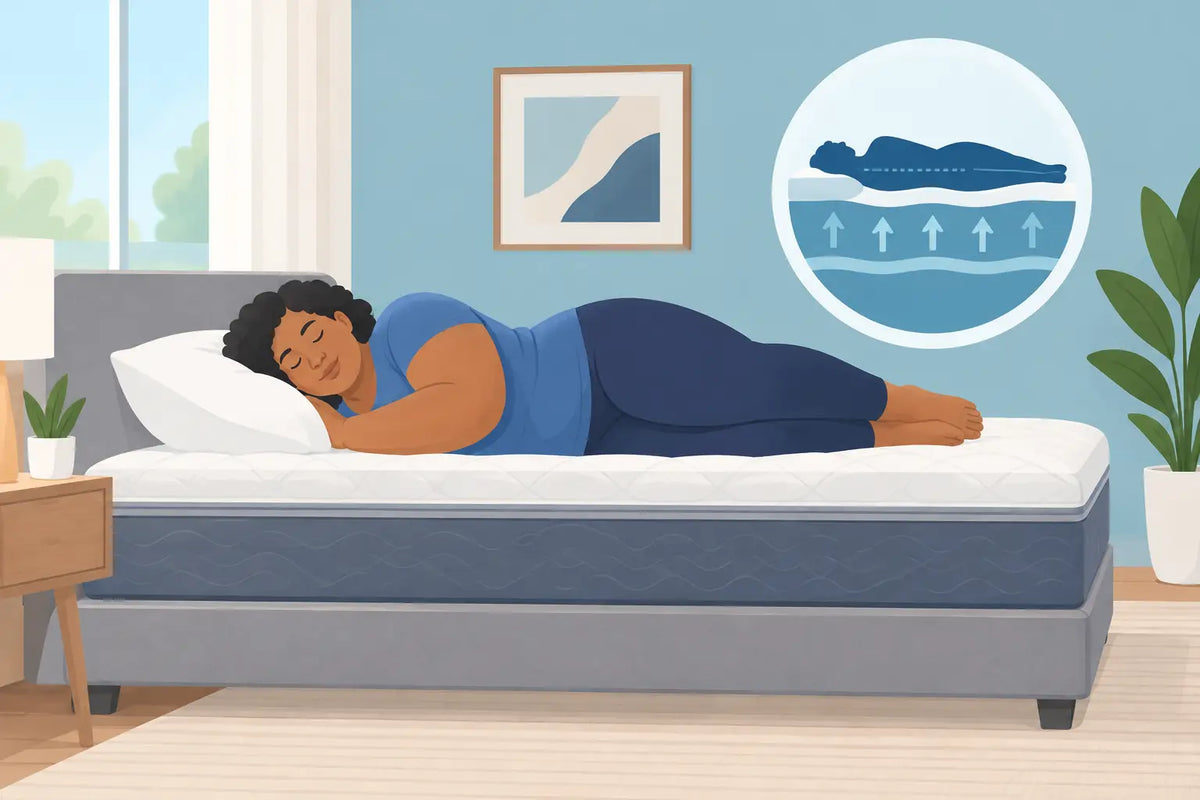
A mattress can feel comfortable for five minutes in a showroom and still lose its shape far too soon at home. For larger or heavier sleepers, the issue is not simply finding the firmest bed available. This heavier body mattress support guide focuses on the parts that actually carry the load: the spring system, comfort layers, mattress dimensions, edge construction and the base underneath.
The right choice should keep your spine in a broadly neutral position, spread pressure without allowing hips or shoulders to sink excessively, and remain consistent over years rather than months. “Orthopaedic” is often used in mattress marketing, but it has no formal medical standard. Construction details are more useful than a label.
Support and firmness are not the same thing
Firmness is the immediate feel at the surface. Support is how well the mattress holds your body in alignment once your weight is on it. A very firm mattress can still be poorly supportive if its core compresses unevenly. Equally, a medium-feel hybrid can offer substantial support if it has a properly specified spring unit beneath its comfort layers.
Heavier people often need a mattress with more resistance to deep compression, particularly around the pelvis and lower back. That does not automatically mean choosing an extra-firm model. A side sleeper with broad shoulders may need enough cushioning at the top to avoid pressure build-up, while still needing a strong spring core below. A front sleeper usually benefits from a flatter, firmer feel, because excessive sink can put the lower back into an awkward position.
For couples, body weight and sleeping position should both be considered. If one person is much lighter, a uniformly hard mattress may suit one sleeper and feel uncomfortably rigid to the other. Zoned pocket springs, responsive latex and carefully chosen comfort layers can make this compromise more manageable.
The spring unit does most of the heavy lifting
The core is where a mattress earns its keep. Foam-only mattresses can work well when they use a dense, durable support foam, but the specification matters. Low-density foam may feel impressive when new and then soften quickly under regular concentrated load. If foam density is not disclosed, there is little basis for judging its long-term performance.
For many heavier sleepers, pocket springs are a sensible starting point. Each spring works independently, allowing the mattress to respond to different areas of the body rather than behaving as one broad, connected surface. This can also reduce movement transfer when a partner turns in the night.
Spring count is worth looking at, but it is not a shortcut to quality. Counts are often quoted for a king size and can be inflated by very small springs. The wire gauge, spring height, coil design and how the unit is layered all affect the result. A lower gauge number generally means thicker wire, although manufacturers should state the full construction rather than relying on one headline figure.
A substantial pocket spring unit with a supportive insulator layer is usually a better sign than a high spring count paired with thin materials. Two-tier spring systems can offer a particularly balanced feel: larger springs provide the primary support, while smaller springs above refine comfort and response. They are not essential for everyone, but they are worth considering where durability and pressure distribution are priorities.
Open-coil mattresses can be economical and practical for occasional use, children’s rooms or guest beds. For everyday use by a heavier adult, however, a stronger pocket sprung, hybrid or heavy-build construction will usually provide better contouring and more consistent support over time.
Do not judge a mattress by depth alone
A deep mattress is not automatically a strong mattress. Extra depth can come from generous comfort fillings, which may be useful, but it can also conceal a light-duty core. Look for a clear explanation of what makes up that depth: spring unit, support foam, natural fillings, latex, upholstery layers and tufting.
Hand tufting is one construction method that can be relevant. Tufts secure fillings through the mattress, helping to limit migration and maintaining a more stable sleeping surface. It creates a traditional, firmer feel than an untufted pillow-top, so it will not suit everybody. But for buyers who prefer a flatter, more anchored surface, it has a practical purpose beyond appearance.
Comfort layers should cushion, not swallow you
The top layers affect pressure relief, temperature and the way the mattress feels when you first lie down. They also affect how deeply you sink. For a heavier sleeper, very thick soft memory foam can become restrictive, especially if you sleep warm or find turning over difficult.
Memory foam is useful for contouring and can reduce pressure around shoulders and hips. The trade-off is slower response and, in some constructions, greater heat retention. Gel additives and cooling covers may alter the initial feel, but they do not replace breathable materials or sensible mattress design.
Latex is naturally responsive and resilient. It tends to recover quickly when you move, offers a buoyant rather than enveloping feel, and allows more airflow than many dense foams. Natural fillings such as wool, cotton, cashmere, horsehair and coir also have distinct roles. Wool can help regulate moisture and temperature; horsehair adds spring and airflow; coir provides firm, dense support. These materials should be selected for the feel and construction you want, not because a natural-filling label alone guarantees suitability.
A hybrid mattress combines springs with foam or latex layers. It can be a good route for heavier sleepers who want pressure relief without giving up a supportive spring base. Check the depth and type of the comfort layers, rather than assuming every hybrid is built to the same standard.
Mattress size gives your body room to settle
A mattress that is too narrow concentrates body weight over a smaller area and makes it harder for couples to sleep without disturbance. If the bedroom and bed frame allow it, moving from a double to a king size can make a meaningful difference, particularly where both sleepers are larger-framed.
Length matters too. As a straightforward rule, choose a mattress at least 10 to 15 cm longer than the tallest sleeper. Feet hanging over the end may lead to altered sleeping positions and can make a supportive mattress feel less supportive than it is.
Standard UK sizes do not fit every frame or every room. An antique frame, a boat berth, an alcove or an unusually tall sleeper may need a different width, length or depth. A made-to-measure mattress should be built around the exact internal dimensions of the frame, allowing a small practical tolerance so it fits without being forced into place. The support specification should not be an afterthought simply because the size is unusual.
Edge support and the bed base matter
If you sit on the side of the bed to dress, sleep close to the edge, or share with a partner, edge support deserves attention. A reinforced perimeter can make the usable sleeping area feel larger and reduce the pronounced roll-off found on lighter constructions. It should not be mistaken for a claim that the whole mattress is firmer, but it is valuable in daily use.
The base must support the mattress as well. A sprung divan changes the feel and can add some give; a platform top provides a firmer foundation. With slatted frames, check that slats are securely fixed, evenly spaced and not bowed or broken. Wide gaps can allow the mattress to sag between slats and put unnecessary strain on its core.
For any mattress, follow the manufacturer’s guidance on suitable bases and rotation. Some one-sided mattresses should be rotated head to toe, while double-sided models may be turned as well. Regular rotation cannot repair an under-specified mattress, but it can help distribute normal wear more evenly.
A practical way to choose
Start with how you sleep rather than a generic weight category. A heavier back sleeper may prefer a medium-firm to firm pocket sprung or hybrid mattress with a stable core. A heavier side sleeper may need the same substantial support with more pressure-relieving material above it. If you sleep hot, prioritise airflow through springs, breathable fibres or latex rather than relying on a cooling slogan.
Then look for facts: the spring type, whether the mattress is single or double sided, the listed fillings, the construction method, its total depth, suitable base requirements and the guarantee. A stated maximum user weight can be helpful where supplied, but it is not the only measure of quality. The question is whether the mattress is designed to resist repeated compression while remaining comfortable for your shape and sleeping position.
At Cadar Beds, this is where made-to-order construction can be useful. A non-standard size does not need to force you into a thin, compromised mattress or a generic off-the-shelf specification. The dimensions, spring system and upholstery can be considered together.
A good mattress should not ask you to sleep carefully to preserve it. Choose one with a clearly explained core, enough room for the people using it, and a feel that supports rather than merely resists you. That is a sounder basis for better sleep than any vague firmness label.