
Custom Mattress for Boat Berth: What Matters
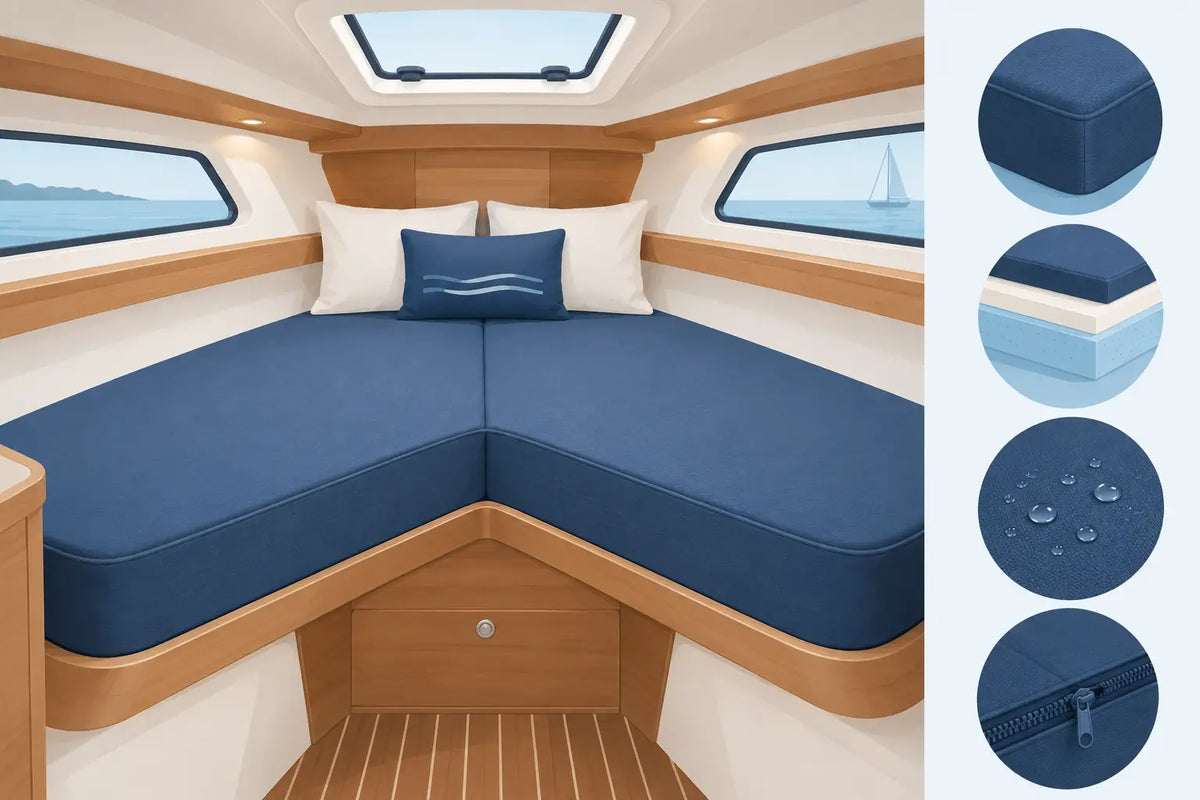
A boat berth is rarely a neat rectangle. It may narrow at the feet, finish in a point at the bow, curve around cabinetry or need to lift with a hatch. That is why a custom mattress for boat berth is not simply a standard mattress cut smaller. It needs to follow the shape accurately, suit the available headroom and cope with the damp, changing conditions found aboard.
A poor fit leaves gaps that collect bedding and make a compact berth feel smaller. More importantly, the wrong construction can hold moisture underneath, restrict access to storage or make sleeping at anchor far less comfortable than it should be. The answer is not necessarily the thickest or most expensive mattress. It is the right build for the berth, the boat and the people using it.
Start with the boat berth, not a mattress size
Most berths should be measured as individual spaces, even where they look close to a familiar small double or single size. A few centimetres matter when a mattress sits between hull sides, locker lids and timber trim.
Measure the maximum length and width, then measure again at several points along the berth. For a V-berth or tapered bunk, record the width at the head, centre and foot. Also note any corners that are rounded, clipped or shaped around a mast support. If the berth has a pronounced curve, a simple set of measurements may not be enough.
Make a full-size template for irregular shapes
For a shaped berth, a paper or card template is usually the clearest route to an accurate result. Lay sheets together over the base, trim them to the inside edge and mark the head end, foot end and the top surface. Include cut-outs for posts, steps or access panels.
Do not assume that port and starboard berths mirror each other. Older boats in particular can have small differences introduced by joinery, lining or hull shape. A template removes guesswork and gives the maker something more useful than a rough sketch.
Measure the depth separately. A mattress that is too deep can make it awkward to sit up, obscure a porthole, foul a locker lid or reduce the space between the berth and the cabin roof. In many cabins, a well-made 15 cm mattress is more practical than a 25 cm domestic model.
Choose the construction for how you use the boat
The right filling depends on whether the boat is a weekend cruiser, a floating holiday base or a liveaboard home. It also depends on whether the berth is used every night, how much ventilation the cabin has and what level of support you prefer.
Foam is often the practical choice for shaped berths
High-quality foam can be cut accurately into tapered, curved and pointed shapes. It is comparatively light, which matters if the mattress must be lifted to reach storage, and it can work well where there is limited depth.
Memory foam adds pressure relief, particularly useful for hips and shoulders on a firm berth base. It does retain more heat than some other materials, however, so it is not automatically the best answer for a warm cabin or anyone who sleeps hot. A breathable cover and decent airflow beneath the mattress become more important in that case.
A firmer reflex foam build can be a sensible option for occasional use, children’s berths or spaces where easy lifting matters most. Foam quality matters far more than a fashionable label. Density, depth and the overall layering determine how it will feel and how well it will hold up.
Pocket springs suit larger, flatter cabins
Pocket springs give more independent support than a basic open-coil unit and can be a good choice for a broad aft cabin or a relatively rectangular double berth. They are particularly worthwhile when two people share the bed and have different body weights or sleep patterns.
There are limits. Springs add weight and need enough depth to work properly. A very thin sprung mattress is often a compromise, and a tightly curved or sharply tapered berth may be better served by foam, latex or a hybrid design. The aim is not to force a domestic mattress construction into a space where it does not belong.
Natural fillings bring benefits, with a few conditions
Wool, cotton, cashmere, horsehair and coir are valued for their breathable, resilient feel. Wool can help moderate temperature and humidity, while horsehair is naturally springy and allows air to move through the mattress. These materials make sense for buyers who want a more traditional build and are prepared to care for it properly.
On a boat, ventilation is the deciding factor. Natural fillings do not make condensation disappear. No mattress does. If a berth base is cold and closed off, moisture can still build beneath any mattress. Regular airing, a ventilated underlay and avoiding prolonged contact with wet bedding are part of the job.
Moisture management is part of mattress comfort
Condensation beneath a berth mattress is common because the base can sit against a cold hull or enclosed locker. Warm air from sleepers meets that colder surface, then moisture has nowhere to go. Left unchecked, it can lead to a stale smell, mildew and damage to both the mattress and the boat’s joinery.
A breathable mesh underlay creates an air gap and is one of the most useful additions to a boat berth. Slatted bases can help too, provided they are clean, dry and strong enough to support the mattress evenly. If the berth sits on a solid board, lift the mattress regularly when the boat is laid up or unoccupied for long periods.
Choose a removable, washable cover where possible. A mattress protector is also worthwhile, but avoid fully waterproof covers for everyday use unless they are genuinely breathable. A plastic-feeling protector may guard against spills while trapping the moisture you are trying to manage.
Think about weight, access and moving parts
A mattress can fit perfectly and still be wrong for the berth if it prevents you opening the locker below it. Ask how often the mattress needs to be lifted and by whom. A heavy pocket-sprung or heavily filled mattress may be excellent on a fixed platform, but tiresome if you need access to batteries, water tanks or stowage every day.
For a hinged berth base, specify where the hinge sits and whether the mattress needs a fold line. A mattress should not be sharply bent across a pocket spring unit that was not designed for it. In some cases, two separate sections, joined by a cover or used side by side, are more practical than one large piece.
Handles can make lifting easier, but they are carrying aids rather than structural lifting points. If a mattress is routinely moved, keeping the build manageable is more useful than adding decorative features.
Do not overlook firmness and shared comfort
Boat mattresses are often bought for the space first and comfort second. That is understandable, but it is a false economy if the berth becomes the place everyone avoids sleeping.
A lighter person may find a firm foam mattress hard at the shoulder, while a heavier sleeper can feel unsupported by a shallow, soft build. Couples need to consider both people, especially in a narrow berth where changing position is more noticeable. Pocket springs can reduce movement transfer, while a carefully chosen foam or latex layer can soften pressure points without making the whole mattress unstable.
The word “orthopaedic” is not a regulated comfort standard. It does not tell you the spring count, foam density, filling depth or whether a mattress will suit your body. Look instead at the actual construction, total depth, stated firmness and whether the maker can alter the specification for the person using it.
Order from clear dimensions and a clear specification
A made-to-measure service should make the process simpler, not bury it behind a quote request. You should be able to state the shape, width, length and depth, then understand what materials are going inside and what the finished mattress will cost.
Cadar Beds makes mattresses by hand to specified dimensions, including unusual shapes and sizes, so the focus can stay on the details that affect life aboard: the cut, depth, support, weight and materials. Before placing an order, check the finished dimensions against your template, confirm which side is the head end and explain any hatch, hinge or cut-out requirement in plain terms.
Finally, plan for delivery and installation. A large shaped mattress may be easy to get onto the pontoon but difficult to turn through a companionway. In some boats, a rolled foam mattress or sectional design is the sensible choice. Measure the route from dockside to berth as carefully as the berth itself.
The best boat mattress should disappear into the background once fitted: no gaps to fight with, no compromised storage access and no reason to wake stiff after a night on the water. Get the shape and ventilation right first, then choose the comfort build that makes the berth somewhere you genuinely want to sleep.