
Best Mattresses for Adjustable Beds That Bend Well
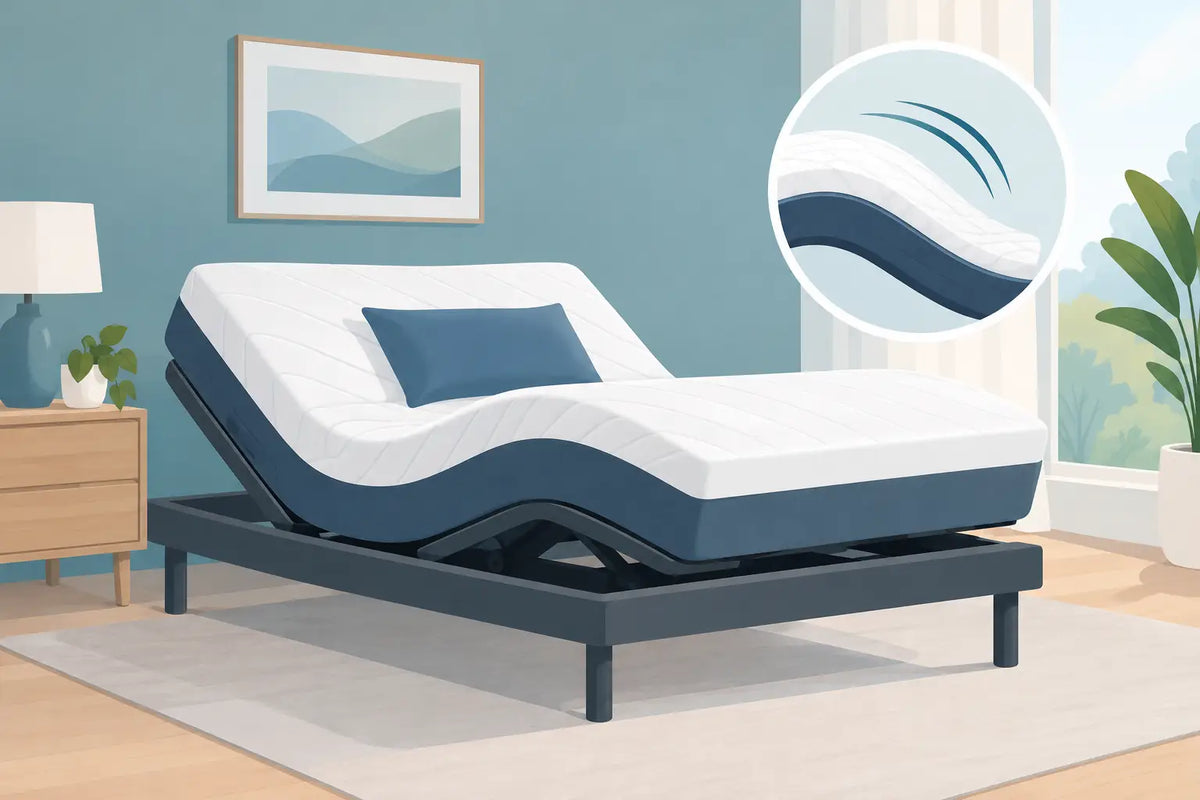
An adjustable base can make an ordinary bedtime routine much more comfortable. Raise your legs after a long day, lift your upper body to read, or find a position that takes pressure off a sore hip. But the best mattresses for adjustable beds are not simply the softest ones, or the ones with the boldest claims. They must flex repeatedly without losing their shape, while still giving you proper support when the base is flat.
That rules out a surprising number of mattresses. A mattress may feel excellent on a showroom bed yet be unsuitable for an articulated base because its spring unit, border construction or natural-filling layers resist bending. The sensible starting point is compatibility, then comfort.
What an adjustable-bed mattress needs to do
When the base rises at the head or knees, the mattress has to follow its movement. It should bend smoothly rather than bridge across the joints of the base, and return to a level surface afterwards. A mattress that is too rigid can strain its own construction, put extra load on the motor and leave uncomfortable gaps beneath your body.
Flexibility is only half the job. The mattress still needs to distribute your weight, keep your spine in a reasonably neutral position and avoid excessive heat build-up. For couples, it should also suit two sleepers who may use the base differently.
Check the adjustable-bed manufacturer’s guidance before buying. Some bases specify a maximum mattress depth or weight, while others require a mattress without rigid side supports. If the mattress warranty excludes use on an adjustable base, treat that as a clear no, whatever the sales description says.
The best mattress types for adjustable beds
Memory foam: the easiest option for flexibility
Memory foam mattresses are often the simplest choice for an adjustable bed. Foam bends easily, has no connected spring frame to resist movement and generally conforms well as the base changes position. It is particularly useful for sleepers seeking pressure relief around the shoulders, hips and lower back.
The trade-off is heat and feel. Traditional memory foam can retain warmth and gives a slower response when you change position. This suits some people and frustrates others. Look for an open-cell foam construction, breathable cover or a comfort layer designed to disperse heat if you tend to sleep warm.
Do not assume that thicker means better. A very deep foam mattress can be heavy and less cooperative on a base with pronounced articulation. The best depth depends on the base specification and the sleeper’s needs, but a sensibly proportioned mattress will usually perform better than an unnecessarily tall one.
Latex: responsive, breathable and naturally springy
Latex is an excellent adjustable-bed material where budget allows. It is flexible, resilient and more responsive than memory foam, so you are less likely to feel stuck when turning over. Its open structure can also offer better airflow than dense foam.
Natural latex has a substantial, buoyant feel rather than the slow sink of memory foam. That makes it a strong option for combination sleepers and those who want pressure relief without a deeply enveloping surface. It is also durable when properly constructed.
There are different latex types and blends, so ask what is actually inside the mattress. “Latex” on a label may mean a generous comfort layer or a thin sheet placed over foam. The thickness, density and overall construction matter more than the word alone.
Flexible pocket sprung: support without a rigid feel
A pocket sprung mattress can work very well on an adjustable base, provided it has been designed for it. Each spring sits in its own fabric pocket, allowing the unit to respond more independently than an old-style open-coil system. This can provide good support, airflow and reduced partner disturbance.
The key is the spring unit and the mattress perimeter. An adjustable-bed-compatible pocket spring unit needs to flex through repeated movement. Rigid border rods, heavily tensioned side stitching and inflexible spring constructions can be a problem. A mattress maker should be able to state plainly whether the model is suitable for an articulated base, rather than leaving you to guess from a spring count.
Spring count alone is not a measure of quality or suitability. It can be quoted in several ways, sometimes including smaller comfort springs. Focus on the type of spring, the quality of the upholstery and whether the finished mattress is approved for adjustable use.
Hybrid mattresses: useful, but read the construction
Hybrid mattresses combine springs with foam, latex or other comfort materials. A well-made hybrid can offer the pressure relief of foam with the support and ventilation of pocket springs. Many are compatible with adjustable bases.
However, hybrid is a broad marketing term, not a construction standard. One hybrid may have a flexible pocket unit and shallow foam layers; another may be too deep, stiff or heavy for your base. Check the manufacturer’s explicit compatibility statement, mattress depth and any weight limit before ordering.
Mattress types that need more caution
Open-coil mattresses are usually less suitable for adjustable bases. Their springs are linked together, which makes the whole unit move as one and can make repeated bending more demanding on the mattress. Some models may be approved for particular bases, but this should never be assumed.
Traditional natural-filling mattresses can also be difficult. Wool, cotton, horsehair and coir are excellent materials in the right bed, and a hand-built mattress can be remarkably comfortable and long-lasting. Yet deep layers, hand-tufting and firmer natural fibre pads may reduce flexibility. A natural mattress intended for an adjustable base must be designed around that movement from the start.
This is where made-to-order construction is useful. If you have an unusual adjustable frame, an antique surround or a non-standard size, the mattress must match more than its width and length. It needs the correct depth, flexible construction and a shape that works with the moving platform.
Choosing firmness for an adjustable base
The base changes posture, but it does not replace mattress support. A mattress that feels comfortable when flat can become unsupportive when your knees or back are raised if it is too soft for your body weight. Equally, a very firm mattress may create pressure at the shoulder when you sleep on your side.
There is no medical definition for “orthopaedic”, despite how freely the term is used. Choose firmness according to your body weight, sleeping position and preference instead. As a broad guide, lighter side sleepers often prefer a softer comfort layer, while heavier sleepers and many back or front sleepers need a firmer, more supportive build.
For couples with different requirements, two single mattresses on a dual adjustable base are often more practical than one large mattress. Each person can select their own firmness and adjust their own side without disturbing the other. The centre gap is the compromise, so this arrangement works best where independent movement matters more than a continuous sleeping surface.
Practical checks before you order
Before committing, measure the moving section of the base, not only the outer frame. Adjustable beds sometimes use dimensions that differ slightly from standard UK mattress sizes. Measure width, length and the available depth beneath any headboard or footboard.
Then confirm these points with the mattress supplier:
- The mattress is specifically approved for adjustable or articulated bases.
- Its depth and weight are within the base manufacturer’s limits.
- There are no rigid border wires or construction details that prevent bending.
- The warranty remains valid when used on your particular type of base.
- The mattress can be turned, rotated or cleaned as recommended without disrupting its design.
Do you need a special mattress retainer?
Most adjustable bases have a small retaining bar at the foot to stop the mattress sliding when the head section rises. Use it if the base includes one. A compatible mattress should sit securely without needing straps, clips or improvised fixes that could affect its movement or damage the cover.
A fitted mattress protector is worthwhile, especially for a mattress that cannot be regularly flipped. Choose a protector with enough stretch to move with the mattress. A tight, heavily quilted cover can restrict the surface more than people expect.
The sensible way to buy
Start with the base specification, then choose the mattress material that suits how you sleep. Memory foam is usually the straightforward flexible choice; latex adds cooler, springier comfort; and an adjustable-compatible pocket sprung or hybrid mattress can deliver a more traditional supportive feel.
For standard and unusual dimensions alike, ask direct questions about construction rather than relying on labels. A good mattress should not merely bend on day one. It should be built to keep doing so, night after night, while giving your body a comfortable place to rest.