
Best Mattress for Heavier People Explained
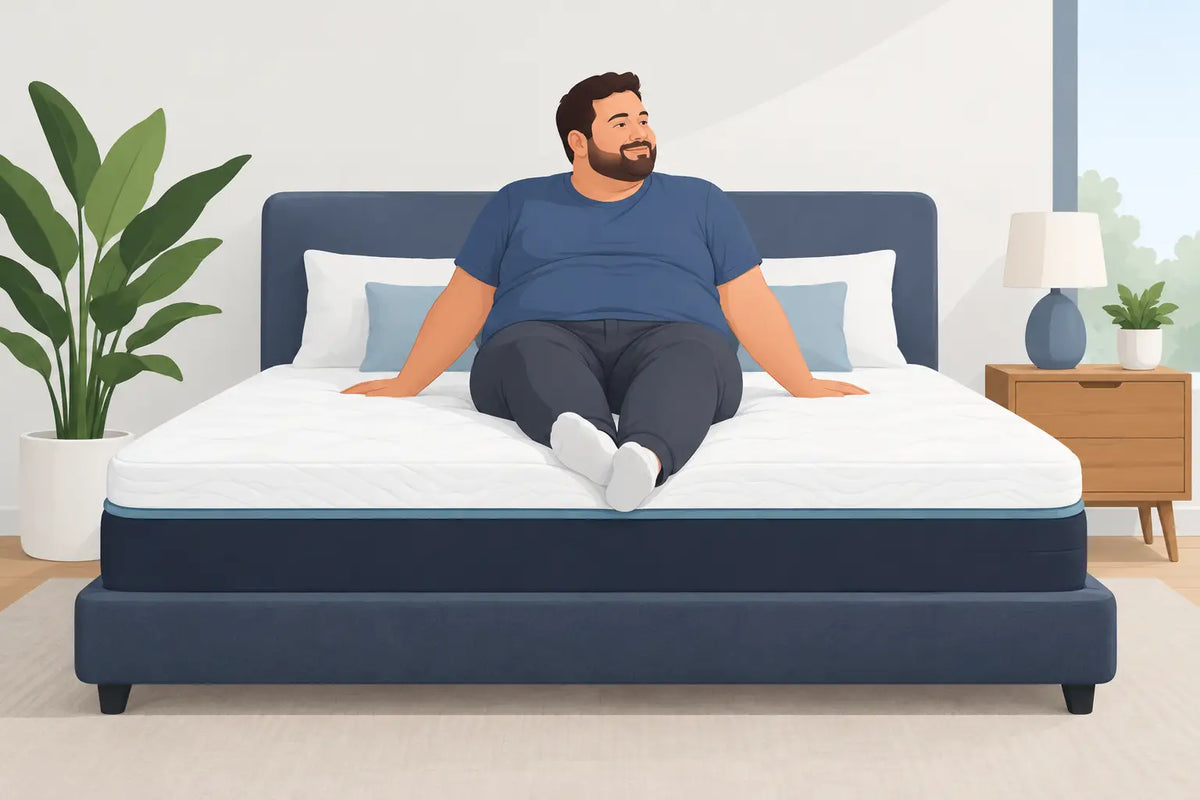
A mattress that feels comfortable for five minutes in a showroom can feel very different after eight hours, particularly when it is carrying more weight night after night. The best mattress for heavier people is not simply the firmest one available. It needs to hold the body in a stable, comfortable position without creating pressure at the shoulders, hips or lower back, and it must retain that performance over time.
That calls for looking past vague labels. Terms such as “orthopaedic” have no formal medical standard, and “luxury” says nothing useful about spring construction, fillings or durability. A better buying decision starts with the parts that actually do the work: the spring unit, comfort layers, edge support, depth and the size of the sleeping surface.
What heavier sleepers should look for in a mattress
For most people, support is the central issue. A mattress should allow the heavier parts of the body, usually the hips and shoulders, to settle slightly while preventing the spine from sagging into a curve. If the middle of the mattress drops too far, the lower back can feel strained. If the surface is too unyielding, side sleepers may wake with sore shoulders or hips.
Body weight matters, but sleeping position and body shape matter too. A person who sleeps on their back may prefer a firmer feel than a side sleeper of the same weight. Couples also need to consider combined load. Two sleepers sharing a standard double put far more pressure on the mattress than one person, particularly around the centre and edges.
In practical terms, look for a medium-firm to firm mattress with a substantial support system and enough comfort material above it to relieve pressure. Very soft, deep foam designs can initially feel inviting but may allow some heavier sleepers to sink too far. Equally, an extra-firm mattress with minimal upholstery can feel hard rather than supportive.
The best mattress for heavier people usually has springs
A well-built pocket sprung or hybrid mattress is often a sensible starting point. Pocket springs work independently, so they can respond more closely to where weight is applied. This can help with contouring and reduce the roll-together effect when sharing a bed.
Spring count alone is not a verdict on quality. It is often used as a headline figure because it is easy to advertise. More useful questions are how the springs are arranged, whether they are suited to the mattress size, what sits above them, and whether the finished mattress has a stable border. A high spring count paired with thin fillings and poor edge construction is not automatically better than a lower-count unit built properly.
For a heavier person, a mattress with a strong pocket spring core and a firmer tension is generally more dependable than a lightweight open-coil model. Open-coil mattresses can be perfectly serviceable for occasional use, children’s beds or a tighter budget, but they tend to offer less independent support and less resilience under sustained load.
Some mattresses use two layers of springs. This can give a responsive surface above a more substantial support layer, particularly in deeper hand-built designs. It is not essential for everyone, but it is worth considering where long-term durability, a larger bed size or a heavier combined sleeping weight is the priority.
Do not confuse firmness with support
Firmness describes the initial feel of a mattress. Support describes whether it keeps your body aligned. They overlap, but they are not the same thing.
A good firm mattress should still have a proper comfort layer. Natural fillings such as wool, cotton, horsehair, cashmere, coir and latex each change the feel in different ways. Wool helps manage moisture and adds a resilient, breathable layer. Latex has a springy, pressure-relieving feel and recovers quickly. Coir is firmer and is often used to add structure. These materials need to be considered as part of the whole mattress, not as isolated selling points.
Memory foam can work well for pressure relief, but density and depth matter. A thick, soft foam layer may create excessive sink for some larger sleepers and can retain more warmth than a sprung, breathable construction. A hybrid design, where foam is used in moderation over pocket springs, may provide a better balance for those who like contouring without feeling stuck in the bed.
Mattress depth and edge support are not minor details
A deeper mattress usually allows more room for substantial springs and comfort fillings. That does not mean every deep mattress is better, but a very thin mattress has limited space to spread load and provide cushioning. For regular adult use, especially where durability is important, a more substantial build is generally worth considering.
Edge support matters too. A reinforced perimeter makes it easier to sit on the side of the bed and helps make full use of the sleeping area. This is particularly useful in a double or king size shared by two people. It also reduces the feeling that you may roll outwards when sleeping close to the edge.
Check your bed frame before choosing a deeper, heavier mattress. Slatted bases should have closely spaced, properly supported slats, while divan bases must be in sound condition. An unsuitable base can affect feel, wear and ventilation. The mattress and base are a working pair, not separate purchases.
Choose the right size before upgrading the comfort layers
A mattress that is technically supportive can still be a poor choice if it does not provide enough room. For solo sleepers, moving from a single to a small double can make a noticeable difference. For couples, a king size often gives each person more usable width than a double, especially if one or both partners are broader-framed or restless sleepers.
Length deserves equal attention. Ideally, the mattress should be at least 10 to 15 cm longer than the tallest sleeper. Feet pressed against the end of the bed encourage awkward sleeping positions, and this is easy to overlook when buying a standard UK size.
This is where made-to-measure production has a practical advantage rather than being a novelty. An unusually tall sleeper, an antique frame, a boat berth or a room with an awkward recess may need a precise width and length. Cadar Beds can build mattresses to specified dimensions, allowing the size and construction to suit the frame rather than forcing the buyer into the nearest standard option.
How to judge durability before you buy
No honest manufacturer can promise that every mattress will feel the same after years of use. Materials settle, especially in the areas that carry the most weight. The useful question is whether the mattress has been built with enough quality material and support to age gradually rather than developing early dips and weak edges.
Look for clear information about the construction. You should be able to establish whether the mattress uses pocket springs, foam, latex or natural fillings; its overall depth; its stated tension; and whether it is single-sided or designed for turning. If a description relies almost entirely on lifestyle language, it gives you little basis for comparison.
A turnable, double-sided mattress can offer a longer working life because wear is shared across both sleeping surfaces. It does require effort, and a heavy mattress is not easy to turn alone. Rotating it head-to-toe at regular intervals is still worthwhile for most mattresses, provided the manufacturer’s care guidance allows it. If you need a one-sided mattress, choose one with a durable support core and rotate it consistently.
A sensible way to narrow the choice
Start with your sleeping position, whether you share the bed, and the dimensions you genuinely need. Then decide on the feel: medium-firm for a little more cushioning, firm for a flatter and more stable surface, or a tailored construction if partners have very different needs.
Next, prioritise a substantial pocket sprung or hybrid design, appropriate mattress depth and a supportive edge. Consider breathable natural fillings or latex if overheating is a concern, and be cautious of very thick, soft foam comfort layers if you dislike deep sink. Finally, check the trial terms, guarantee, fire-safety compliance and the suitability of your existing base.
The right mattress should not make you work to find a comfortable position. It should give your body enough room, hold its shape under regular use and feel reassuringly stable from the centre to the edge. That is a far more useful standard than any fashionable label on the mattress border.