
Benefits of Hand Tufted Mattresses Explained
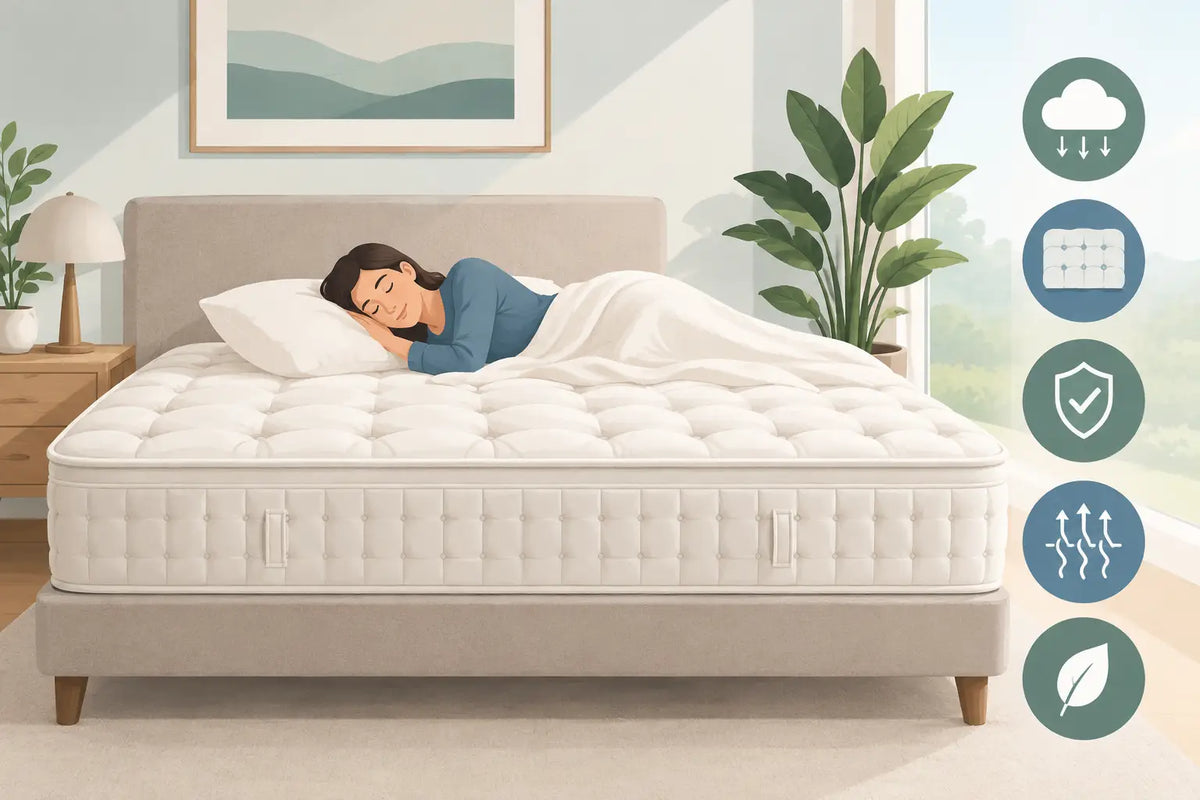
A hand-tufted mattress has visible tufts or buttons across its sleeping surface, but they are far more than a decorative detail. The benefits of hand tufted mattresses come from the way those tufts hold the internal layers together under tension. Done properly, this is a practical construction method for keeping springs and fillings working as intended over years of use.
It is particularly relevant when a mattress contains substantial natural fillings, such as wool, cotton, cashmere, horsehair or coir. These are loose, breathable materials rather than a single bonded foam block. They need to be secured carefully. Hand tufting helps do that without relying solely on heavy adhesives or a tightly stitched top panel.
What hand tufting actually means
In a genuinely hand-tufted mattress, a skilled maker passes strong tapes through the mattress from one side to the other, then tensions and secures them by hand. The tapes are positioned at intervals across the sleeping surface and finished with woollen tufts, buttons or felt pads.
This differs from a quilted mattress, where the cover and comfort layers are stitched together on a machine. Quilting can be perfectly suitable, especially for foam, hybrid and roll-packed mattresses. It simply serves a different purpose. A quilted top generally creates a flatter, plusher-looking surface; hand tufting creates a more structured mattress with a recognisably traditional finish.
The word “hand tufted” should describe an actual construction process, not just a patterned cover. If a product description does not explain what is tufted, what sits beneath it, or which fillings are used, the label alone tells you very little.
Benefits of hand tufted mattresses for support and longevity
It keeps loose fillings in place
Natural fillings compress and settle gradually as a mattress is used. That is normal. Wool, cotton and horsehair are valued because they can regulate temperature and contribute to a comfortable, resilient feel, but they must be layered and held securely.
Tufting anchors these layers through the full depth of the mattress. It limits sideways movement and helps prevent the fillings from migrating into one area. The result is a more consistent feel across the bed, rather than a comfort layer that gradually shifts away from where it is needed.
This matters even more in a deep mattress with several layers of upholstery. A well-made natural mattress may contain spring units, insulator pads and multiple comfort fillings. Tufts help those components behave as one considered build rather than a stack of materials that can move independently.
It adds useful structural tension
A hand-tufted mattress tends to feel firmer and more controlled at the surface than an equivalent mattress with a thick, loose quilted top. The tapes gently compress the fillings at each tuft point, creating tension throughout the mattress.
That does not automatically make it hard. The underlying spring system, filling depth and your body weight still determine the overall comfort. However, hand tufting can reduce the overly pillowy, less stable sensation some people find on heavily padded mattress tops.
For sleepers who prefer to sleep on the mattress rather than sink deeply into it, that controlled surface can be a real advantage. It is also often appreciated by people who find it difficult to turn over on a very soft bed, although a mattress cannot diagnose or treat back, hip or joint conditions.
It supports a longer working life
No mattress remains unchanged forever. Fillings settle, springs experience repeated loading and covers wear. The aim is not to prevent all change, but to choose a construction that ages sensibly.
Because hand tufting secures the upholstery through the mattress, it can help preserve the original shape and tension of a substantial build. It is one reason traditional pocket-sprung mattresses with natural fillings are often designed to be turned and rotated. Regular care allows both sides to share the work and gives the fillings a chance to recover.
Durability still depends on the quality of the spring unit, the amount and type of filling, the user’s weight and whether the mattress is supported by a suitable base. Tufting is valuable construction, not a substitute for good materials.
It suits breathable natural-filling designs
Hand tufting is often found on mattresses built with wool, horsehair, cotton, cashmere and coir. These materials can help manage moisture and air movement, each in a different way. Wool, for example, can absorb and release moisture vapour; horsehair is springy and naturally open in structure; coir provides a firmer, more supportive layer.
The tufted finish does not create breathability by itself. A mattress made mostly from dense foam does not become naturally ventilated because it has buttons on the surface. What tufting does well is hold breathable, loose fillings in their correct layers without flattening the whole mattress into a sealed, heavily glued construction.
For people who sleep warm, the full specification matters more than any single feature. Look at the filling list, depth of upholstery and whether the mattress is designed for regular turning.
A more stable choice for larger and made-to-measure beds
The larger the mattress, the more strain is placed on its materials. A king-size, super-king or oversized made-to-measure mattress has a broad surface area and may be used by two people with different body weights and sleeping habits. Hand tufting gives the upholstery more anchor points across that area.
It is also useful in specialist dimensions. An antique frame, a boat berth or an unusually long bed should not force you into a cheaply adapted mattress with unsuitable materials. When a mattress is made to a precise width, length and depth, the internal construction should be planned for that size too. Tuft placement, spring layout and edge support all deserve consideration.
This is where factory-made-to-order work has an advantage over a generic mattress cut down after production. The dimensions are only one part of the specification. The mattress must still be built to hold its shape and offer even support from edge to edge.
The trade-offs: hand tufting is not for everyone
Traditional craftsmanship is useful, but it is not automatically the best option for every sleeper. A tufted surface has shallow dips between the tufts. Some people enjoy the secure, tailored feel; others prefer the smooth, level surface of a quilted or pillow-top mattress.
Hand-tufted mattresses are also commonly heavier, particularly when they contain dense natural materials and a substantial pocket spring unit. They may need turning, which is worthwhile but not convenient for everyone. If you cannot safely lift or manoeuvre a heavy mattress, a no-turn design may be the more sensible choice.
They are not usually the obvious option for vacuum-packed next-day delivery either. Many hand-tufted mattresses are best delivered flat because their deeper, layered construction is not intended to be tightly rolled and compressed. That is not a fault. It is simply a different type of product with different delivery requirements.
Finally, do not assume a hand-tufted mattress will be soft, supportive, cool or luxurious just because it carries that description. Those qualities come from the complete build. Ask about spring count and type, comfort fillings, mattress depth, firmness guidance, turning requirements and the base it will sit on.
How to decide whether a tufted mattress is right for you
A hand-tufted mattress is worth considering if you want a traditional, durable construction with natural or layered fillings held securely in place. It is especially well suited to sleepers who prefer a stable surface, buyers choosing a heavier pocket-sprung mattress, and anyone ordering a non-standard size where build quality matters as much as the measurements.
It may be less suitable if you want a very plush, perfectly smooth top, need a lightweight no-turn mattress, or expect the mattress to arrive rolled into a compact carton. There is no prize for choosing the most traditional option if it does not suit your room, bed base or ability to care for it.
When comparing mattresses, look beyond the tufts. A clear material specification and an honest explanation of the construction will tell you far more about the bed you will sleep on every night. Choose the feel and build that fit your body, your bed frame and the practical reality of your home.